Wednesday, June 13, 2018

Conservative Christians and Suicide

Since the suicides of Kate Spade and Anthony Bourdain, I've been thinking about suicide and its causes. I've spent some time googling statistics. I'll share a few things I've learned.

Here are some facts about suicide and guns.

  • Firearms account for over half of all suicides. (Source: American Foundation for Suicide Prevention)
  • Almost two of every three gun deaths is a suicide. (Source: Every Town Research)
  • Of those who attempt suicide with a gun, nine out of 10 die from the attempt. (Source: Every Town Research)
  • Of those who attempt suicide without a gun, fewer than one in 10 dies from the attempt. (Ibid)
  • Most of those who survive a suicide attempt do not attempt again. (Ibid)

One of the most surprising things I learned is this: More than half of people who die from suicide did not have a known mental health condition. (Source: CDC)

I had assumed that the correlation between mental illness and suicide would be much higher. I don't know that I expected it to be 100%, but I definitely expected it to be much more than half, not less than half. Even so, mental illness correlates to death by suicide very strongly.

LGBQ teens are almost 3 times as likely as straight teens to attempt suicide (Source: CNN). We don't have numbers for transgender teens. However, transgender people are almost 10 times more likely to attempt suicide than the general public (Source: USA Today). LGBTQ teens who experience family rejection are 8.4 times more likely to attempt suicide than LGBTQ teens who do not experience family rejection (Source: American Academy of Pediatrics). We don't know much about death from suicide among the LGBTQ community because sexual orientation is not part of a death record.

Religiously unaffiliated are more likely to attempt suicide. (Source: American Journal of Psychiatry
I didn't find any studies that broke that out by atheists, agnostics, ex-Christians, ex-Muslims, etc. I would be very interested in learning more about that. This article is a very interesting read on the suicide problem among atheists. Below is an excerpt.

So, what I learned is that suicide is very complex. There is no easy predictor. There is no easy way to discern the warning signs. There is no antidote like a vaccine to prevent suicide. It's a messy problem that usually begins with a messy situation and then leaves the family behind in a messy situation. Suicides are rising at an alarming rate, and there is no easy way to fix it.

So, what is a Christian response? I believe that conservative Christians should take a long hard look at themselves. I believe that the church, especially conservative Evangelicals, should consider how their politics, theology, and behavior may be contributing to the problem of suicide. Yes, it's uncomfortable, but we must look at ourselves.

The strongest correlation to death by suicide isn't mental illness or substance abuse or sexual orientation. It's access to firearms. People with access to firearms are 3 times more likely to die from suicide (Source: Fox News). How can we who claim to be pro-life also be so pro-gun? I have never understood the conservative Christian obsession with guns and the second amendment. It's baffling to me how one can claim to follow the non-violent Jesus while loving guns. Every time a school shooting happens, conservative Evangelicals resist any discussion of gun control laws. Since neither of the high profile suicides last week were by a firearm, gun laws didn't hit my social media news feeds. But gun control should be top of mind any time we want to talk about ways to decrease suicide deaths. Gun control is an obvious way to reduce suicide deaths in America.

Second, many conservative Christians have a tendency to stigmatize mental illness. I've heard things like, "He doesn't have a mental illness problem; he has a sin problem." I've heard advice given to mentally ill people that they should pray more. Prayer is good and helpful and powerful. However, it is not a simple fix for mental illness or depression. Often, professional counseling and medicine are needed to control, not cure, mental illness. And sometimes, even this only helps marginally.

Also, consider how conservative Christians treat the LGBTQ community. Ostracizing gay people is common in conservative Christianity. Many conservative Christians teach and practice rejecting and cutting all ties with gay members of their family. I have witnessed family ostracism of an LGBTQ family member first hand. It's painful and ugly. How many simply pretend to be something they're not to avoid ostracism? I've already noted that family rejection dramatically increases the risk of a suicide attempt in gay teens. This "Christian" ostracizing of LGBTQ family and friends is a contributing factor to the higher rate of attempts in the LGBTQ community. Christians must reconsider how they treat LGBTQ family members and the entire LGBTQ community.

And finally, consider the higher rates of suicide attempts among the religiously unaffiliated. I've heard Christians use this statistic to tout the virtues of Christianity. I've heard this statistic used to argue that all men crave God and those who refuse to believe have nothing but emptiness and that's why they're more likely to attempt suicide. More likely, the lower suicide rates among Christians is more likely attributed to the fear of hell. It's good that the suicide rates are lower for Christians. We should be thankful for that without being arrogant and patting ourselves on the back for having gotten this religion thing correct. We need to be considerate also.

Consider that many atheists, especially in the South, are ex-Christian. And as such, often their Christian family and friends have abandoned them. I know several atheists with this experience. All the ex-Christian atheists I know didn't arrive at their position overnight. They carefully studied and arrived there through much grappling with science and Scripture. They're sincere. I disagree, but I respect the courage to grapple and to do so with integrity. Sadly, I've watched Christians patronize and belittle atheists, calling April 1 "National Atheists Day" while quoting Psalm 14:1. Then, there's the oft repeated and patronizing phrase that atheists hate to hear, "I'm praying for you." 
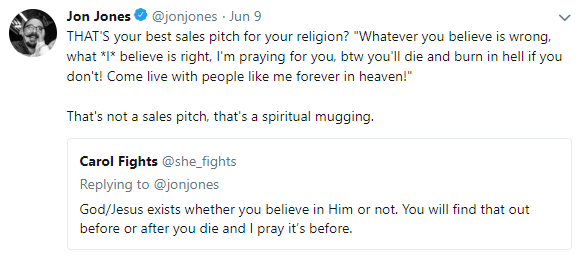
Here's an example of how not to talk to an ex-Christian atheist.

To be clear, I'm not blaming Christians for the increased suicide rate. I'm simply asking us to examine ourselves and see if we need to change our theology, attitudes, politics, and behavior to be more helpful in bringing light and love to people and see if we can contribute to helping the problem of suicide. According to the CDC, isolation, access to lethal means, stigma associated with seeking help for mental health, and religious affiliation are all risk factors for suicide. Let's not isolate our LGBTQ friends and family members. Let's not isolate our atheist friends. Let's end our obsession with guns. Let's end our stigmatizing of mental illness. And let's draw people to relationship with Jesus in loving ways. All of these things will contribute positively to reducing suicide risk factors. 

Friday, May 4, 2018

Teacher's Guide to the Book of Romans (SATIRE)

Before reading this post, keep in mind that it is satire. I wrote this a long time ago when I was sitting through a church of Christ Bible class on the book of Romans. Remember, it's tongue in cheek. I'm a member of a church of Christ and have been for over 25 years, so I think I've earned the right to poke fun at our tradition. It's okay to laugh at ourselves. This post is just that. A little fun. If it offends someone, well, that probably means that it's satire. Remember that satire stretches the truth and risks offending people for the cause of humor.

Here's my chapter by chapter breakdown of Paul's letter to the Romans to make the Church of Christ Bible Class teacher's job just a little easier.

Chapter 1. Romans 1:28 Atheists are stupid and homosexuals go to hell.

Chapter 2. Romans 2:1 This chapter kinda sounds like don't judge, but don't get confused. It really means you can judge if you keep God's law, and we keep God's law better than anyone else, so we can judge.

Chapter 3. Romans 3:23 Everybody has sinned. We even have sinned, but that was before baptism and now we have quit sinning.

Chapter 4. Don't let Romans 4:5 confuse you. Works are definitely part of salvation. Let's turn over to James 2 so we can understand Romans 4. Paul really means that we're saved by faith AND works. Paul is difficult to understand and James is easy to understand.

Chapter 5. Romans 5:6-8 are great for a Lord's Supper talk. Be careful with the rest of this chapter. We're sure it does NOT teach total depravity (Romans 5:12) and we're really, really, really sure it does NOT teach universalism (Romans 5:18). We know that only a very few go to heaven, so don't get confused by the phrases "grace abounding" (Romans 5:20) and "many made righteous".

Chapter 6. SEE! YOU DO HAVE TO BE BAPTIZED TO BE SAVED!!!!!!!!!!!!!!! Spend as much time as possible in this chapter. Be sure to also mention Acts 2:38. Mark 16:16. Acts 22:16. 1 Peter 3:21. Baptism, baptism, baptism, baptism.

Chapter 7. See, we are right about marriage, divorce and remarriage. Romans 7:2-3 We don't know about this struggle Paul describes in the last part of this chapter because we've quit sinning Romans 7:19.

Chapter 8. This chapter is tricky. Don't get confused by the "no condemnation" in Romans 8:1. You have to be "in Christ", for there to be no condemnation. You are only "in Christ" if you were baptized for the right reason, in the right way, into the right church, and then only if you continue worshiping in the right church and repent of every sin you commit.  So, most who think they're in Christ are not actually in Christ and will be condemned. Next, everywhere you see "the Spirit" in this chapter, replace it with "the completed New Testament revelation". And whatever Romans 8:38-39 are saying, they're NOT teaching once saved always saved or perseverance of the saints. Paul says nothing can separate you from God's love. But remember that you can separate yourself from God. Your biggest responsibility here is to prevent people from becoming secure in their salvation and to prevent people from thinking that the Spirit does anything apart from the written word.

Chapters 9-11. We have NO idea what these chapters are about, but we're very, very, very sure that the Calvinists are wrong about them. Romans 11:22 is good. Behold the SEVERITY of God. God is SEVERE. Very SEVERE. Remember God's SEVERITY.

Chapter 12. Be transformed. That means worship correctly without musical instruments and don't have any fun. Transformed people don't wear shorts, don't drink alcohol, don't cuss, etc. If people don't think you're weird, you're probably not transformed enough. Romans 12:20, if your enemy is hungry, feed him, but don't use church funds to feed him.

Chapter 13. This is the Republican chapter. Don't break the speed limit or you'll go to hell. Romans 13:4 is why we support the death penalty.

Chapter 14. The stricter you are the stronger your faith is. And this chapter for sure isn't saying that we can disagree about important stuff like musical instruments. We're not sure which disagreements are allowed, but we're pretty sure it's okay to be a vegetarian (Romans 14:2), but we can't imagine why anyone would want to do that. What would you eat at a pot luck if you were a vegetarian? Maybe some brethren in California are vegetarians? Anyway, even though Romans 14:21 says essentially the same thing about wine as it does meat, you're weird if you don't eat meat. And you still for sure can't drink alcohol of any kind, including wine. We can't disagree about that.

Chapter 15. Romans 15:4 means to use the Old Testament when it supports our doctrine. We learn that shorts are sin from the priests' garments and most importantly we learn that musical instruments are sin from Nadab and Abihu (ironically). Don't get too carried away with Old Testament examples because the Old Testament has been nailed to the cross and has no authority. Sometimes, though, we need more than Romans chapter 1 when teaching about homosexuality, and the story of Sodom comes in very handy then. The rest of chapter 15 basically says "be good" and then something about Paul's travels.

Chapter 16. Romans 16:16! See! We have the right name! Church(es) of Christ!!! Never mind the first half of verse 16 because kissing is weird and we don't do that any more. Romans 16:17! Withdraw from everyone who disagrees! By the way, pretend there are no women in this chapter. Look over there, a squirrel! (Whew! that was close! Someone almost said "Phoebe". It's probably best to avoid talking about Phoebe, but if someone brings it up you need to be ready. Maybe bring it up yourself if you're feeling bold, but be very careful. Remember that even though Paul calls Phoebe a deacon of the church at Cenchreae, she wasn't a deacon of any church. Women can't be deacons. Everyone knows that. She probably was a really good cook and maybe a good ladies Bible class teacher. She was probably a great helper for her husband, whoever he was. The worst and hardest is if someone notices Junia. Avoid Junia no matter how bold you feel. No matter what Paul said about Junia, she was not an apostle. If someone does bring her up, be sure to throw shade at translations that say she was "of note among the apostles". Throwing shade at almost every English translation is your only hope with Junia. Man, it sure would have been nice if Paul had put verses 16 and 17 at the beginning of this chapter so then we could have covered those verses and conveniently run out of time before Paul starts commending all these women.)

Whew. Some of those chapters were really difficult. Peter wasn't kidding when he said that some of what Paul wrote was difficult to understand. Not impossible, but difficult. Follow this guide and you'll be okay.

Monday, April 2, 2018

CENI

CENI stands for Command, Example, and Necessary Inference. The conservative churches of Christ claim to require a command, example, or necessary inference in the Bible for everything they do. They teach CENI as the only acceptable hermeneutic.

Doy Moyer argues in his book Mind Your King and in various sermons that CENI is not a hermeneutic system. Rather, it simply describes the communication process. Moyer argues that the communicator tells, shows, or implies. Tell, Show, Imply (TSI) is Moyer's restatement of CENI from the communicator's point of view. The receptor perceives a command, example, or makes an inference. So, CENI or TSI only reveals the information, the raw data which must be interpreted and applied. Interpretation and application are not addressed with CENI or TSI. Since hermeneutics is the science of interpretation, CENI cannot be a hermeneutic system.

I mostly agree with brother Moyer's sagacious observation. I think there are more nonverbal cues involved, even in written communication. Also, the relationship between the communicator and the receptor add a lot of nuance that can't really be captured with TSI. However, I agree that generally, when someone criticizes or teaches CENI as a hermeneutic system, they are conflating the verbal communication process with the science of interpreting what has been communicated. Stated another way, CENI is neither a good nor a bad hermeneutic system because it isn't a hermeneutic system.

Since this is true, what then about hermeneutics in the conservative churches of Christ? When CENI is claimed as a hermeneutic, that ultimately becomes another way of saying, "We just do what the Bible says." I've argued in a series of posts that nobody does "just what the Bible says." Everyone who claims that the Bible is authoritative interprets and applies the Bible. We must make a distinction between what the Bible actually says and our own interpretations of the Bible. What the Bible actually says is the CENI, the raw data. Our interpretation is the result of applying our hermeneutic system to the CENI. Everyone interprets the Bible. Every. One.

What is missing in conservative churches of Christ is a well-defined hermeneutic. Calling CENI a hermeneutic is not good enough. What is needed is a consistent set of principles that can guide one in the interpretation and application of the Bible. This is lacking in those who claim CENI as their hermeneutic.

I'm not arguing that CENI is invalid. I'm arguing that CENI is NOT a hermeneutic. Sure, you can find examples of folks following CENI in the New Testament. Doy Moyer argues (Mind Your King, p34-37) that it's CENI that instructs Peter in Acts 10. I've heard it argued elsewhere that it's CENI that comes up with the letter to the church at Antioch in Acts 15. I don't disagree that you'll find examples of CENI in the New Testament. But it is not true that EVERY time there is communication from God that the recipient of the communication only adhered to the CENI and nothing more. There are several examples where interpreters went beyond CENI to make an application of Scripture or other commands from God. (1 Cor. 9:9-10; Gal. 3:16, 4:24-31, et al. This could be multiplied many times over where NT authors make an application that takes many liberties with the text and goes well beyond what is explicitly stated or necessarily implied in the Hebrew Scripture.)

Interpreting the Bible is hard work. Volumes upon volumes have been written about how to interpret Scripture, both at the scholarly and popular level. Some good popular works on this topic are How to Read the Bible for All Its Worth (Gordon Fee and Douglas Stewart) and Scripture and the Authority of God (N.T. Wright). Since Scripture is living and powerful (Heb. 4:12) and it guides a living body (the church) through a living and changing creation, it makes sense that the methods for interpreting it will change over time. It's dangerous hubris to say or imply or act as if "We've figured out the Bible and we just do what it says."

In my resistance to CENI as a hermeneutic over the years, I've heard and read several attacks of a straw man. Those defending CENI suggest that there are some who wish to do away with "examples" and "necessary inferences" as sources for authority and only stick with commands. That's not my point at all. Maybe some have suggested this, but most objections to CENI do not suggest that we follow "commands only". My point is that there are commands, examples, and necessary inferences in the Bible that do not apply to 21st century Christians. Every 21st century Christian lives by this reality to some degree or another. We need to frankly admit this, that we violate direct commandments in the New Testament, and get busy working out WHY we do this. What I've found is that there is a variety of reasons that words in ancient texts don't apply today and there is a lot of room for diversity of interpretation and application. How closely someone's interpretation resembles yours is not a reliable gauge for his sincerity or respect for the Bible's authority.

In summary, CENI as a hermeneutic is just another way of saying, "We just do what the Bible says." This statement is patently and demonstrably false for everyone who claims it. Nobody just does what the Bible says. Everyone interprets the Bible to make application to their setting and situation. Many deny that they interpret the Bible and claim to "just do what the Bible says", but this is excessive arrogance at worst and dangerous ignorance at best. Don't obstinately refuse to admit that you interpret the Bible. Interpretation, per se, is not a bad thing. Sure, there are bad interpretations. Ironically, many bad interpretations grow out of denying interpretation.

Good interpretation is hard work. It requires depending on and respecting modern scholarship. It requires community. It must above all be Christ centered and love biased.

Sunday, March 27, 2016

Celebration!

Easter is the most significant day on the Christian calendar to me. The resurrection is the anchor for my faith. It's only been recently that I've learned that there is freedom to celebrate this, and celebrate it heartily. For many Christians Easter follows a fast that creates an eager longing for the celebration of Easter Sunday, though the celebration usually ends that same day. For some Christians, Easter is the one time of year to go to church, and not much thought is given to Easter before or after the dress-up Sunday.

For other Christians, and this is true of many of those who share my Christian heritage (the churches of Christ), Easter is mostly ignored. There may be a mention of celebrating the resurrection weekly while others do it only annually. If there is no mention of that, it will likely be ignored, even though the crowd is larger, the ladies and girls are wearing bright new spring dresses, the men are wearing pastels, hams are in the oven at home, baskets are filled with candy, and an Easter egg hunt is planned for the afternoon. To these Christians, the holiday is only secular and there is no special celebration of the resurrection on this Sunday.

One of my favorite stories in the Old Testament is the story of Hezekiah restoring the Passover in Judah as told in 2 Chronicles 30:1-23. It had been years even centuries since Jerusalem had celebrated the Passover. Hezekiah invited those left by Assyria in Israel to come join the festivities. The king, the Levites, and the people were bursting with excitement. The people were so excited that many, especially the guests from Israel, observed the Passover while unclean because they couldn't wait until they had time to become clean. Hezekiah prayed and God healed them. The festivities lasted a full week, as prescribed in the law, but that wasn't enough for them. They wanted more celebration! So they agreed to continue another seven days of celebration of the Passover. God's law has been discovered! The land is rid of idols! Many from Israel have come to Jerusalem for the first time for this important celebration! This is Judah's first Passover in ages! With excitement and agreement, they continued celebrating another full week.

What a beautiful picture of restoration of joy in the Lord!

I believe the church at large, and especially those in my religious camp, need this type of celebration of Easter. We have ignored Easter long enough. We need a Hezekiah-like searching for those outside who give scant thought to the resurrection. We need a long, joyous, and creative celebration of music and art and clapping and shouting for joy and anything new and beautiful. While we have those in our presence who may never attend church any other time, why not blow them away with our excitement for Jesus and his resurrection? We need a renewal of our commitment to take up the worthy vocation of serving people. We need to show the world that the resurrection brings life and joy and hope, not just to "a people" but to "ALL PEOPLE".  And filled with love for God and love for his people we bring life and joy and hope to all through our renewed vocation fueled by an exciting and refreshing celebration.

Like Hezekiah, our renewal may only be a one-time thing. It may only last two weeks or six weeks or two months. But it would be better for it to start joyously and fizzle than to never happen at all. But who knows... It may be just the spark needed. It may be just the renewal and energy that begins a sustained new vocation that touches and changes many more lives.

Note: Lest anyone think I'm this clever, this is more or less NT Wright's thoughts applied specifically to the restoration movement.

Tuesday, March 1, 2016

Books of 2015

I meant to do this back in December. I simply haven't been writing as much lately. I haven't written about running and I haven't written about theology. I've still been reading quite a bit about both, but I just haven't been writing as much. I should start writing more again. Another reason I haven't written as much, especially about theology, is that writing has been cathartic for me. Now that I'm in a community that allows for differences in theology. I've been able to get things off my chest without needing to write it down. Ahhh. What a relief! This has the added benefit that I've learned a lot from others and that I've gotten some immediate corrective feedback that wasn't harsh and didn't require complete agreement and wasn't compounded by the stress of heaven or hell stakes.

In addition to the books listed below, I spent a large amount of time in Genesis and Chronicles (both first and second) and the minor prophets in the Old Testament. I also spent a good deal of time in 1 Corinthians and Matthew in the New Testament. I didn't read much variety by way of blogs this year. I did read a good bit from Jay Guin at http://oneinjesus.info, but he posts very often and his posts are sometimes so long that I simply didn't have time to read nearly all of his stuff, but I enjoy what I read. I also read Scot McKnight's Jesus Creed when I can. He also posts very often, so I by no means read it all.

Anyway... The books of 2015 in no particular order...

  1. Jesus Interrupted by Bart Ehrman. I really liked this book. I wish Bart Ehrman could have somehow maintained his faith through his studies. He's a very smart and articulate man. He very honestly sets forth the difficulties that are in the Bible. Those who suggest that the Bible has no difficulties or contradictions or those who suggest that all of these difficulties and contradictions are easily resolved may be offended by Ehrman's work. Also, Ehrman shows a good deal of respect to scholars who have seen the same evidence that he has seen but who still maintain their faith. As Ehrman says in this book, he's just bringing to light to the general public, the laity if you will, things that pretty much any seminary student already knows. I highly recommend it to anyone who's serious about the Bible and theology. Seminary students and scholars won't find anything new in this book, but I did.
  2. The Myth of a Christian Nation by Greg Boyd. Another very good book by Greg Boyd. I didn't just like this book, I loved it. Boyd expresses several things that have been on my mind for years. I get so fed up with the political posturing of evangelical Christians in America. Many have made being a conservative a pre-requisite for being a Christian. The evangelical right puts much energy into turning America back to God. I hear too much talk about making America a Christian nation like it once was. Boyd argues that there is no such thing as a Christian nation. There is only one kingdom God is interested in today and that kingdom is ruled by King Jesus. Greg Boyd is an outspoken and devout pacifist. Given that my roots are in the Stone-Campbell Restoration Movement, I really can relate to and understand his pacifism. Pacifism has had strong support in the Restoration movement, perhaps most notably with David Lipscomb. Unfortunately, the Restoration Movement has by and large drifted away from pacifism and has taken on the war-like conservative rhetoric of other evangelical denominations. I still lean strongly toward pacifism, tempered with the notion that pacifism will be beautiful and ubiquitous in the afterlife, but it's just not practical in the now-life. Sometimes, good guys have to use violence in this fallen creation. I believe that God has called many to pacifism and I respect that and I believe God is using them for great good. I also believe that God has called some soldiers and policemen and He uses them for great good. Anyway, this is one of the best books I've ever read, even if I don't agree with some of it.
  3. The Dead Key by D.M. Pulley. This was a very nice debut by D.M. Pulley. A good, original thriller. There was lots of back and forth from 1978 and 1998. Sometimes that was difficult for me to follow, but it really worked well for the book. Also, I LOVED that this was set in Cleveland. What an unusual setting for a thriller! That's Pulley's hometown, and after reading the book I visited Cleveland and the accuracy with which she described the city was incredible. I also spoke to some of the locals about the events described in 1978, and they all remembered it. This was a well-written book. Any Clevelander would probably enjoy this book. And if you're not from Cleveland, the story is exciting and interesting enough to reel you in anyway.
  4. Crow Hollow by Michael Wallace. If you like historical fiction, you'll probably dig this book. It was a good story of a mother in search of her child that was stolen from her. It paints the horrific picture of the savage violence that accompanied the settlement of the English in New England. The reader gets to experience the brutally cold winters, the treacherous travel, the deceptive politics, and the religious division of the pioneers of the 1700s. And it wasn't all bad stuff, either. There is triumph, mercy, nobility and love all along the way, too. I recommend it. 
  5. The Bible Tells Me So by Peter Enns. This book was similar to Jesus Interrupted mentioned above, except that Peter Enns did not lose his faith like Bart Ehrman did. I really liked this book. Enns contrasts a "rule-book" approach to the Bible to a story or narrative approach to the Bible. Must read.
  6. Repenting of Religion by Greg Boyd. Greg Boyd urges the church to repent of judgment and turn to sharing the love of God. This is an excellent read. His main point is that judging is the original sin. It's partaking of the tree of knowledge of good and evil. It's a very interesting perspective, and it seems clear that the church is guilty of judging to the point that we do not love as Jesus loved.
  7. The Forgotten God by Francis Chan. We went through this in a Bible Study. I had read it before, but it was good to read it again in a community setting. It's a challenging read, and one that I struggle to implement.
  8. A Fellowship of Differents by Scot McKnight. A life-changing and thought provoking study of the apostle Paul. I'll probably read this one again. And again. And again. The main point is that we show the world who God is when different people (white, black, old, young, Hispanic, Asian, man, woman, rich, poor, intelligent, simple, gay, straight, engineer, accountant, artist, teacher, student, author, etc. etc.) all come together and live in a community of love. The tragic reality is that churches are segregated along many different types of lines, but especially racial lines. And there's a description of the prepositions of love that is so true that it brought me to tears. Must read.
  9. The Pilgrim's Regress by C.S. Lewis. I kinda feel guilty for listing this one among the books I read this year. I didn't make it all the way through it. I liked what I read, but I didn't really love it like I usually love C.S. Lewis's writing. I'll probably take another stab at this later. As usual with C.S. Lewis, put your thinking cap on before you read.
  10. Surprised by Scripture by N.T. Wright. There wasn't much, if any, new material in this book. But it was good to see N.T. Wright tackle some contemporary issues. It is more or less a collection of essays that may be available elsewhere, but have not been collected together before this book. I especially liked his comments on religion and science, women in ministry, and the problem of evil.
  11. Troublemaker by Leah Remini. If you've ever tried to leave a cult or a religious sect with cult-like tendencies, you will be able to identify with many parts of Leah Remini's story. Though I'm no prude, I found her language to be unnecessarily harsh and vulgar and that detracted from the book. Besides that, I did  enjoy hearing her tell her story and I hope she continues to find peace and healing outside of Scientology.
  12. To Kill a Mockingbird by Harper Lee. I reread this book for two reasons. First is that my daughter had to read it for school, and I wanted to talk to her about the book and story. Second was to prepare for reading Go Set A Watchman. I hadn't read To Kill A Mockingbird in years, and I was reminded why this is an American classic. What's not to love about this book? 
  13. Go Set a Watchman by Harper Lee. I had to read this because To Kill A Mockingbird was just so good. I liked Watchman, but it was no Mockingbird. One of the lessons that stands out to me even though this is a work of fiction, is that it is improper to judge historical figures by the moral standards of our day. As progressive as Atticus was in Mockingbird, he was on the wrong side of segregation in Watchman. The other lesson I learned was from Jean Louise. Even if you're right on an issue, you won't win people over by angrily arguing your point.
  14. The Lost World of Genesis One by John Walton. This is a very important read for anyone who has struggled with the disconnect between the fundamentalists' young earth and the scientific evidence for an ancient earth. Walton helps to heal the divide by pointing out that Genesis one is about functional origins and does not address the topic of material origins. His main point is that there is no need for the friction between those who believe in a young earth and those who believe in an ancient earth. A functional origin and temple centered view of Genesis 1 really says nothing about material origins and hence the age of the earth. 
  15. The God Delusion by Richard Dawkins. It's not often that I say this about a book, but I hated this book. It's not because I disagree with it, though I certainly disagree vehemently with most of it. I really wanted to give this book a fair shake. I went into it with an open mind, and I will say that Dawkins makes some valid points. However, his tone ruined it for me. I have never seen such arrogant, elitist vitriol and chronological snobbery. Do you believe in God? Then Richard Dawkins despises you. Reading this book reminded me of how I felt when I read Muscle and a Shovel by Michael Shank. It's a book that resonates well with those who agree with it, but that insults those who do not. I would like read another book that tries to build a case for atheism. I'd love to better understand the position, and this book helped some with that, but I had to overcome his condescension and insults just to get to his actual arguments. Then, he went way overboard by saying that raising a child in a religion is a worse form of abuse than sexual abuse. I don't think I can ever read another word from Richard Dawkins. Only read this book if you agree with Dawkins or if you love being insulted by an elitist.
  16. Make it Stick by Peter Brown. This was a great introduction to the science of learning and remembering. It gave me some great tools to use as I try to learn new material and make it stick so I can use it later. Highly recommended. The main point is spaced practice is critical to learning and learning that is difficult sticks better than learning that is easy. 
The best book I read this year goes to A Fellowship of Differents by Scot McKnight. This is a very important book. The church desperately needs to mix it up. the world is a segregated mess. Right now, the church looks like the world in this. The church needs to be a salad.

Friday, May 22, 2015

Strait, Narrow, and Few

In my last post, I talked about Scripture flowing in one direction on a topic, but then sometimes we see "rocks" that interrupt that flow. One of these "rocks" that I mentioned is Matt. 7:13-14. I've been wrestling with Matt. 7:13-14 for some time now. Some would just tell me to accept the fact that few go to heaven and almost everyone goes to hell. End of discussion. It's settled.

Only that doesn't settle it for me because I see a strong current in Scripture moving toward an earth that is full of righteousness and a heaven with innumerable hosts. It's surprising how often this appears.

It's in the Pentateuch in Numbers 14:21. Here, there are only a few. There are two faithful out of about 2 million and God is ready to wipe them out. Moses appeals to God's mercy and forgiving nature and God responds with forgiveness and mercy and states that "all the earth shall be filled with the glory of the Lord." He does not withhold punishment in this incident, and reminds us of the virtue of justice. But He forgives and pardons and redeems and preserves those two and raises up an entire faithful nation that inherits His promises.

This statement in Numbers 14:21 is repeated almost verbatim in Habakkuk 2:14. Again, it's a context of wickedness overwhelming righteousness, and here is this promise. The earth will be full of the knowledge of the glory of the Lord as the waters cover the sea.

In probably the most Messianic Psalm, Psalm 22:1-31, we have a very interesting promise in Psalm 22:27. The Psalmist is forsaken by God, surrounded by enemies mocking and abusing. But eventually God hears and delivers, and promises that "all the ends of the earth shall remember and turn to the Lord."

There are several verses like this in the Psalms.(Ps. 72:19; 86:9; 66:4; 102:15; 98:1-3, etc. etc.)

And Isaiah? Isaiah surely believed that the whole of the earth was going to honor God. Isaiah 11:9 is essentially the same as Habakkuk 2:14. Isaiah 11 is in a context of the kingdom of God covering the whole earth and is one of the most beautiful descriptions of the earth being full of peace and righteousness in all of Scripture.

And I haven't even talked about Revelation 7:9-12. And Revelation 15:4. And there are many more. Research for yourself.

Some may say, "but those passages are figurative and prophetic". I'll grant that for some of them. But even so, the figures and prophecies have meaning. The overwhelming flow is toward an earth filled with people who know God. You have to try to miss that in the Old Testament. And the innumerable hosts in heaven stands in contrast with few entering a narrow gate.

Yet the most common explanation of Matt. 7:13-14 that I've heard is a reversal of this flow. This explanation says, "Very, very, very few go to heaven. Almost everyone goes to hell." It's as if Jesus came along and on the Sermon on the Mount said, "By the way, all those promises about the earth knowing and turning to the Lord, I'm reversing those. Just a very few people are truly approved. 'Us and them' is the right way to think after all."

The churches with which I've been associated have especially relied on this passage. These churches have shaped my faith and made me much of who I am today. I owe an incredible debt of gratitude to them for my Bible knowledge, study habits, friends, family, good work ethic, appreciation for purity, and many other good things. I love those churches, my people. But these churches have isolated themselves from all others who claim to be Christian and used Matt. 7:13-14 as justification and as comfort for this isolation.

I no longer believe the "us and them" use of this passage is correct or good. According to Wikipedia, these churches have about 120,000 members. There is considerable evidence that the number of members is shrinking at an alarming rate. If their isolation is correct, then less than 0.0017% of the world's population makes it. That isn't a narrow gate. It's a closed gate.

I'm not completely sure what Matt. 7:13-14 means. Consider the immediate context that promises that "all who seek will find" and "whoever knocks, it will be opened for him" (Matt. 7:7-8). The immediate context emphasizes that the Father knows how to give good gifts and wants to give them more than we do (Matt. 7:11). In light of that, I don't think He's saying that there's a pattern for worship hidden in the New Testament and about 1 out of 100,000 in the world will find it and those will be rewarded with the good gift of heaven while the rest of the world just won't get the blessing of God's eternal goodness.

However, no matter the numbers and despite its contrast from the context, Matt. 7:13-14 still has meaning. I do not want to ignore this verse. I do not want to ignore the flow of Scripture. How can I honor both?

The rock is still there and the river is still flowing and God's voice is in this sound of the flow against the rock. The earth and heaven will be filled with innumerable people who know God and His love and justice and peace. Few enter the narrow gate that leads to life and many go the broad way to destruction.

One idea that I think has some merit is this: Jesus was speaking exclusively to a Jewish audience. Those in that Jewish audience were His contemporaries. His teachings were very strange and contrary to them. Very few of His Jewish contemporaries would heed His word. Maybe.

Perhaps He is talking about a way of life more than eternal destiny. He's talking about a way of life that truly lives by the golden rule and gives to the needy and shares and puts others' needs above one's own. There are really few who truly live self-sacrificially, even though that is a brilliantly simple and fulfilling yet difficult ethos that brings life. Perhaps.

Or maybe He really is saying that only Christians will be saved and there will be few of them. In the world today, about 2 out of 7 people claim to be Christian. Even if "not every one who says Lord, Lord" (Matt. 7:21) makes it to heaven, a little over 2 billion is enough to cover the earth but it's still a relatively narrow gate. Maybe.

Or maybe the truth is in the sound of the flow against the rock. Just like Joshua and Caleb were alone among the spies and the vast numbers in the whole camp of Israel, God redeemed the camp and raised a nation. To this nation in His perfect timing, He sent His Son. His Son was alone and rejected and abused and killed. Even though His followers disbanded and forsook Him in His darkest hours, God raised Him. And God redeemed those followers who disbanded and turned them into the church, the kingdom of God, that now covers the earth. In spite of overwhelming odds and a very small beginning, God's name and glory will cover the entire earth and God will continue to redeem the faithfulness of His servants to spread love and peace and justice. That's what I think is the best explanation.

But for sure, I'm convinced that Matt. 7:13-14 is NOT a passage to give any one tiny sect a raison d'etre. It's not intended for folks to quote then congratulate themselves for being the few who figured out God's true will. It's not intended for people to use as justification for sitting on their hands and isolating themselves from other followers of Jesus. It's not there to give comfort for a small sect's own numbers falling because "broad is the way" and "this evil world doesn't want the truth". I'm sure of that.

Instead of worrying about who's in and who's out, I should put more effort in loving God and loving others. More like Him.

Wednesday, May 13, 2015

When Scripture Has Rocks

One of my favorite things to do is to run on the trails in DeSoto State Park. One trail parallels the Little River, which is a fast flowing river that flows mostly south and mostly atop Lookout Mountain and eventually forges a canyon to the south of the state park. The water rushes along and you can hear it from quite some distance away. Occasionally, as I'm looking at the river, I'll see a large rock, maybe several large rocks just sticking up above the water. The water hits the rock, turns white, makes noise, and flows around the rock, continuing southward.

These rocks add beauty to the river. These rocks make the water rough. These rocks make the river more difficult to navigate. These rocks amplify the voice of the river and sometimes make the flow of the river even more obvious. Ignore these rocks and you'll miss the river's voice. You'll miss the river's beauty. And if you're in the water, ignore these rocks to your own peril. To attempt to ignore them is both futile and dangerous. However, to pick up and go the complete opposite direction because a rock stands against the flow of the river is even more futile and dangerous.

Sometimes we have Bible verses like those big rocks.

What I mean is this. The overall sweep of Scripture is flowing very strongly in one direction, but there are verses that jut out, like big rocks on a fast river. These verses seem to oppose the flow of the "river". When we see those, we have to choose. Will we turn and go against the overall flow of Scripture? Will we attempt to ignore them? Or will we admire the beauty and roughness and navigate around them listening for God's voice in the noise caused by these verses that seem to oppose the flow of Scripture?

Examples of passages that are like these rocks...

Matthew 7:13-14 is a passage that I've wrestled with for some time. There is an overall flow of Scripture, especially in prophecy, toward an earth filled with people who turn to God and who know God. There are innumerable hosts in heaven in Revelation (Rev. 7:9-12; 15:4). There are verses like Habakkuk 2:14; Isaiah 11:9; Ps. 22:27 and Ps. 98:1-3. Does this one passage near the end of the sermon on the mount suddenly reverse all of those? (That's not impossible because the sermon on the mount begins with a set of reversals, for sure.) Or is there another way to understand this verse that honors both this verse and the overall flow of Scripture?

Other examples include the role of women. You have Miriam, Deborah, Anna, the women proclaiming the empty tomb to men, Phoebe, Junia, Philip's daughters, Gal. 3:28, etc. Standing against those you have 1 Tim. 2:12 and 1 Cor. 14:34. What do we make of that? How do we deal with those rocks? How do we decide which verses are the "flow" and which are the "rocks" in my metaphor?

There is an overall flow of a picture of God as merciful, patient, kind, loving. In fact, that is perhaps the major theme of all of the Bible. There are passages like Deut 5:10 and Deut 7:9 and Rom. 5:15 and Rom. 5:17 that show that God's mercy is orders of magnitude greater than His punishment. We are told that God is slow to anger. But then you have Nadab and Abihu (Lev. 10:1-3) and Uzzah (2 Sam. 6:7) and Ananias and Sapphira (Acts 5:5; Acts 5:10). Do we throw out the flow of Scripture toward a merciful and loving God of grace in favor a few "rocks" that on the surface appear to portray God as an angry cosmic despot? Or do we strive to see what else may be going on in those "rock" verses?

Let's take the more difficult road of wrestling with passages that cause us tension. Let's not settle for pat answers. Let's use the tools available to us, including modern scholarship which can help us understand customs and language and culture and audience and author of the books in the Bible. Let's strive to honor all of Scripture, even the parts we don't like or that present problems to our cherished and long-held beliefs. Let's even consider the possibility that we may not be able to reconcile all of these verses and we're just left to honor the beauty of the different perspectives in Scripture. Let's not be satisfied to read Scripture the way we always have. Let's read Scripture as it has been given to us by God (a beautiful story written from different times and perspectives) instead of turning it into what we may want it to be (a uniform, simple, point by point instruction manual).

Wednesday, December 24, 2014

Books of 2014

As I've done the past couple of years, I wanted to review the books I've read in 2014. These are in no particular order. It helps me to keep track of what I've read and when. So, if I need to diversify a bit or if I need to reconsider a position, I have a reference. So, here goes.
  1. The Perfect Mile by Neal Bascomb. This was a fascinating read. I highly recommend it to any runner. Bascomb tells the story of three runners chasing the four minute mile. Of course, the one everyone remembers is Roger Bannister. But two other athletes, Australia's John Landy and Kansas's Wes Santee put the pressure on Bannister. This book is the story of each of these three men as they chased the ever so difficult four minute mile. There were several unsuccessful attempts along the way. It's three stories of resilience, dedication, overcoming adversity, triumph, disappointment, and (in the case of Landy) being just a little too late. It was fascinating and inspiring. It's a must-read for any runner, maybe even any competitive athlete.
  2. Daniels' Running Formula (Third Edition) by Jack Daniels. This is the latest update to the essential running coach's handbook. I read this update as part of obtaining my RRCA coaches certificate. As a side note, I'm now an RRCA certified running coach. I'm still trying to figure out how to use this for the most good. For now, I've just been taking some close friends under my wing and rejoicing as they shatter PRs.
  3. Beyond the Church of Christ by Jeremy Campbell. This is a three part kindle e-book. The link I provided with the title is to part one. Definitely read all three. This is a reality-based fiction short story of one young man's journey away from the exclusive theology of the non-institutional churches of Christ. I highly recommend this whole series for anyone who is struggling with doctrines taught in churches of Christ or who is struggling with the unloving treatment that comes with having honest questions in the church of Christ. I'd also recommend it to those in more progressive churches of Christ to better understand what people who leave the non-institutional churches of Christ have been through. This is a very readable and very true, if fiction, story. Besides all of that, the theology contained in the dialog is pretty solid.
  4. Divergent by Veronica Roth. I read this because my daughters were reading it and I like talking to them about what they're reading. This is one of the rare times where I will say that I liked the movie much better than the book. I'll watch the rest of the movies in the trilogy, but won't read the other books.
  5. The Fault In Our Stars by John Green. Again, I read this because my girls wanted to read it. I actually pre-read this and struggled with whether to let them read it or not. I decided to let them read it because it provided an opportunity for us to talk about some very important things, like death, cancer, sex, dating, love, God, parents, friends, profanity, how to treat those with serious illness or disabilities, etc. This is a very difficult book to read. It's a book that will shake you. It falls on my all time list of best books ever. Take my man card for liking this book if you must. For my daughters, I made them make a list of words that were new to them and then talk to me about each of those new words, what they mean, how they were used in the book, etc. We also talked about the story as they were reading it. Judge me if you must for letting my then twelve year old daughters read this tragic and morbid and profanity laced book, but it provided some excellent father-daughter discussion that I'm not sure I could have gotten on my own.
  6. The Four Disciplines of Execution: Achieving Your Wildly Important Goals by Chris McChesney, Sean Covey, and John Huling. This is a process book that outlines a set of steps for achieving your goals. It is a very good business read and I'll be putting the process into practice with my team at work in 2015.
  7. Switch: How to Change When Change Is Hard by Chip and Dan Heath. If you're going to implement a new process (like the Four Disciplines) then you're going to have to change things. This book covers how to effect change in an organization, with an emphasis on change in the business environment. The principles do not assume that you have authority to make changes by dictate. It is an interesting look at what actually drives behavior in people.
  8. Unity and Diversity in the New Testament by James G Dunn. This is probably one of the more difficult books that I've read. The perseverance was worth it, though. This book is not written at a popular level. It's probably a 300-400 level college book. Good stuff. I really like how he points out the differences in the way different New Testament authors referred to Jesus and the differences in the way they quoted Scripture. Excellent read. I found myself disagreeing with Dunn's conclusions often, but I still very much appreciated his work and point of view.
  9. How To Read the Bible for All Its Worth by Gordon Fee and Douglas Stuart.  If you care at all about hermeneutics, you should read this book now. I really like how they make the distinction between exegesis and hermeneutics.
  10. Scripture and the Authority of God by NT Wright. In my opinion, NT Wright is the best Christian author of our time, and it isn't even close. This is a brilliant look at what authority means. Instead of using our definition of authority and forcing Scripture into that, Wright recommends that we allow Scripture to define and shape what Scripture means by authority. This is another very good look at hermeneutics and how to approach the Bible. I actually read this book twice this year.
  11. Forgotten God: Reversing Our Tragic Neglect of the Holy Spirit by Francis Chan. This is a very challenging read. Not challenging in the sense of difficult to understand. It's actually very straightforward. It's challenging in the sense of "Do you really want the Holy Spirit to dwell in you?" It's a very good read.
  12. Muscle and a Shovel: A Review by John Mark Hicks.This is a kinder review than I could ever have given of Muscle and a Shovel. Hicks points out that there is a fundamental difference in approach to Scripture between himself and Shank. Shank asks in essence, "What does the Bible legally require of me?" Hicks suggests that a better question is this, "What is God's mission and how can I join that mission?"
  13. I did read through Muscle and a Shovel by Michael Shank another time this year, just to see if I could possibly understand how some think this is such an excellent book. And, I just can't figure it out, except that the narrative is so very well done. Apart from the narrative, however, its tone is arrogant and condescending and its theology is just bad. Here is an excellent review by Garrett Best. http://ministryofstudy.wordpress.com/2014/07/14/book-review-muscle-and-a-shovel/
  14. The Ultimate Heresy: The Doctrine of Biblical Inerrancy by Rodger L. Cragun. I randomly met the author of this book while on business travel and we discussed theology over dinner and I picked up this book from him. I really like how he challenges the reader to ask the question, "What is the word of God?" He takes a look at how Scripture uses that phrase (word of God) and points out that Scripture clearly refers to other things besides Scripture when it uses that phrase.
  15. Mind's Eye by Douglas E. Richards. This was a fun read. A pretty exciting sci-fi thriller. No spoilers, but if you like sci-fi thriller mysteries, you'll probably like this book.
  16. The Fallow Season of Hugo Hunter by Craig Lancaster. The characters are very well developed and complex. Every character except the narrator's love has flaws. It's a bit of brilliance that her flaws don't show. This novel isn't at all about the plot. It's about the characters. Realistic. Flawed. Good. Bad. It's a great view of how every human is in some ways a walking contradiction. It's also both timely and timeless. It's set in the present day and the common use of technology and modern medicine and current pop culture make an appearance, but don't dominate. The human nature that is timeless dominates. It is a story of love and loss and anger and frustration and lucky breaks and squandered opportunities and beautiful selfless love. It's also a peek into the underbelly of blood sports which honestly disturbed me a bit.
  17. I also read through two volumes of a workbook titled "First Principles of Christianity" by Robert Harkrider. I have nothing good or nice to say about those workbooks. Horrible, exclusive, pat-answer, shallow theology.
That's fewer books than I wanted to read this year. I read more novels than I realized, which is a good thing. Just reading theology was honestly wearing me out. I have no real good place to discuss the theology I read, so I have to keep it bottled up inside. It sometimes makes me want to explode. Most people just aren't as interested in the theology as I am or they judge me and issue me a one way ticket to hell for considering different points of view. So, reading novels was very refreshing (well, except Divergent which took so much effort just to get through the teeny-bop googly infatuation).

Besides the books, I am still reading various church bulletins, blogs, and running magazines. I'm considering various viewpoints, not just those agreeable to me.

I have a difficult time picking a favorite this year. I almost want to pick a favorite in each category, but I'll just pick one for the year. That one is...


The Perfect Mile by Neal Bascomb. I really enjoyed learning more about the story of the four minute mile. Excellent read.

Saturday, July 12, 2014

Baptism and Fellowship

Over the past few days, an article has appeared on my Facebook news feed a few times, and I want to make some comments about it. The title of the article is "Time for Churches of Christ to Fellowship Other Groups?"

Go ahead and read the article, because I'll be discussing a theme in that article in this post. I think I'm reading that article correctly when I say that the author builds the case that the Church of Christ should not extend Christian fellowship to other groups. That is a belief that is widely held and taught in churches of Christ. I could probably find dozens of articles on the Internet that make a very similar argument.

This one interests me because the author specifically mentions baptism to illustrate why he believes we should not extend fellowship to believers in groups other than the Church of Christ. This article helped me realize that the Church of Christ position on baptism is at the center of the belief that fellowship should not be extended. This belief is sometimes referred to by others as the belief that "they're the only ones going to heaven". So, in this post, I want to look at baptism and how it relates to fellowship in churches of Christ.

But before I do that, I want to mention that I almost agree with what the Church of Christ teaches about baptism. I appreciate the willingness to restore baptism’s importance. The theologies of the reformation went too far in their insistence on faith only and distanced baptism from salvation. Since baptism isn't faith, they argue, it is not connected at all to salvation. However, I do not believe this is correct because the Bible very often connects baptism to salvation. So, I agree with the Church of Christ's emphasis on the immediacy of baptism.

However, I believe that the discussions of baptism in the Church of Christ over the past 50 to 100 years have unnecessarily reduced baptism to essentially two positions. The church of Christ position is that baptism is absolutely essential for salvation and nobody gets to heaven without it. The other position is that baptism is not essential to salvation at all and it may be postponed for weeks or even months. I don’t think the Bible teaches either of these positions, but I believe that the church of Christ position is closer to what the Bible actually does teach about baptism.

Now, let’s look at baptism and how it relates to fellowship in the Church of Christ. The Church of Christ has attached baptism to salvation. There is significant biblical support for that. However, we also have attached understanding the purpose of baptism to salvation, and there simply isn't any biblical support for that. The Bible says, (Mark 16:16) “Whoever believes and is baptized will be saved.” The Bible does not say, “Whoever believes and understands the purpose of baptism and is baptized will be saved.” The Bible says, (Acts 2:38) “Repent and be baptized for the remission of sins.” The Bible does not say, “Repent and understand the purpose of baptism and be baptized for the remission of sins.” The Church of Christ has added “understand the purpose of baptism” as a condition for salvation. The Bible does not attach such an understanding to salvation.

The Church of Christ teaches a five step plan of salvation. (I do not believe in a “five step plan”. I believe that salvation is far more intimate than any step by step process or procedure, but that's a different topic.) However, in practice, we really have believed in a six step plan of salvation. We can provide a Bible verse for five of the steps, but not all six. In our explicit teaching of the plan, we do not include all six. This extra step usually comes up when someone responds to our teaching about baptism with, “But I’ve already been baptized.” After this response, there will often be an effort to show that the baptism was invalid because the person didn't understand the purpose of baptism. "You were not really saved," some say, "because you did not do it for the right purpose. You must be baptized for the right purpose in order to be saved."

Here is the six step plan that I've never seen documented anywhere or heard formally taught, but that we have practically taught.
  1. Hear. (Romans 10:14-17)
  2. Believe. (John 3:16)
  3. Repent. (Luke 13:3,5; Acts 2:38)
  4. Confess. (Romans 10:9)
  5. Understand the purpose of baptism. (There is no Bible verse that connects this to salvation.)
  6. Be baptized. (Mark 16:16)
The result of adding “understand the purpose of baptism” as a condition for salvation is requiring people to be baptized again in order to be accepted. Even someone who was baptized by choice in an effort to obey God, but didn’t understand the purpose of baptism before their baptism, must be baptized again, according to many in the Church of Christ. In effect, we have told people who were previously baptized as an act of faithful obedience that God did not accept their obedience.

The God of the Bible accepted the worship of those in Hezekiah’s day (2 Chron. 30:1-27) even though they did so “otherwise than was written” (2 Chron. 30:18). The God of the Bible looks at the heart and honors obedience from the heart. Technical soteriological understanding is never a biblical requirement for God to honor the obedience of a tender and contrite heart. We (the Church of Christ) need to stop requiring this understanding before we honor the baptisms of others.

Adding the requirement of understanding the purpose of baptism as a condition for salvation serves to separate the Church of Christ from other baptized believers in Jesus. So, baptism becomes a very divisive and isolating issue in the Church of Christ. Jesus prayed for unity. Separating from other believers in Him based on an extra-biblical requirement for understanding does not promote the unity that He prayed for.

The article that I mentioned at the beginning of this post suggests that in order to extend fellowship, because of his beliefs about baptism, he would have to abandon logic, conviction, and scripture.

I wouldn't ask someone to abandon logic I actually very much encourage a well-reasoned faith.

I wouldn't ask anyone to abandon conviction. I would persuade someone to change convictions based on reason and scripture, but not abandon them.

And I'm certainly not asking for anyone to abandon scripture. I actually believe that the extra requirement that the Church of Christ has placed on baptism is not in Scripture and we should get rid of the extra-biblical requirement of understanding the purpose of baptism as a prerequisite to salvation.

At the end of the article, he asks, "Can there ever be unity?" There can never be unity as long as we continue to use baptism as a divisive issue. Instead of using baptism to divide believers, we should honor baptism as the entrance into a covenant with Jesus by bodily confessing His death, burial, and resurrection and continuing to live the new life, proclaiming the resurrection which promotes healing and sharing and unity bringing the kingdom of heaven to earth..

Wednesday, June 11, 2014

Book Review: Beyond the Church of Christ

A friend recommended that I check out Beyond the Church of Christ: Kingdom Life Outside the Walls by Jeremy Campbell. Wow is really all I can say.

Here is the author's description of this short story:
Using the format of a fictional story instead of dry commentary, Beyond The “Church of Christ” is a story of a young man's journey from fundamentalism to freedom, from legalism to liberty.
Though brought up to believe that only members of the “Church of Christ” are true Christians, 24 year old Jason Gibson (concerned at the eternal fate of his departed uncle, who was a devout believer though not a part of the CoC) has now begun questioning some of the core doctrines he was raised in.
Jason sets out in furious pursuit of answers to some troubling questions, embarking on a journey that will change his view of baptism, the church, and Hell. It’s a life-changing journey that is at once both liberating and frightening as he awakens to the glories of God’s grace, yet is now faced with the reality of being ostracized from his family.

The short story is written in three parts, and you can get all three parts for less than $5 total, less than $2 total if you're an Amazon Prime member. Seriously, go get these Kindle books now. Right now. It's an excellent story. It's well written and well told. This guy is a seriously good storyteller. And more than that, he really gets what it's like to study, pray, and agonize over a point of doctrine and come to an honest disagreement with the Church of Christ. Most in the Church of Christ reject the concept of an honest disagreement. So if you have ever had one, you'll instantly relate to the story's protagonist, Jason Gibson. And if you've ever spoken such a disagreement out loud, you'll really relate to the way he was treated.

Several of you may have read or may be aware of a book called Muscle and a Shovel by Michael Shank. If you have read Muscle and a Shovel, especially if you recommended it to me, please, please read this short story. This story is the inverse of Muscle and a Shovel. In Muscle and a Shovel, Mike was raised a Baptist and studied his way into the Church of Christ. In Beyond the Church of Christ, Jason was raised in the Church of Christ and studied his way out of it.

Part One: Click here for the Kindle book.
Part one has a very well done and concise history of the American Restoration Movement, which is the movement that gave birth to the Church of Christ as we know it today. (Though many in the Church of Christ deny this, the historical evidence is overwhelming that every Church of Christ today can trace its history and theology right back to the American Restoration Movement in the 1800s.) Following this, he sets up the background for the beginning of his journey, which is the tragic and accidental death of his Uncle Mark.

Part Two: Click here for the Kindle book.
In part two, Jason begins his journey by discussing two very hot button Church of Christ doctrines: baptism and the pattern for worship. His Aunt Gayle patiently guides him through this discussion. I will say that this is the best and most concise discussion and refutation of the Church of Christ proof texts for baptism that I have ever seen. Campbell does an excellent job of avoiding straw men throughout this story. When he says that the Church of Christ teaches or believes something, he takes great care to represent their teaching accurately. This is a very refreshing approach! I am often guilty of misrepresenting someone when I disagree, and I really appreciate his resisting that ever-so-easy temptation.

Part Three: Click here for the Kindle book.
In part three, after a few conversations with Aunt Gayle, Jason is faced with the horrible dilemma that anyone who honestly disagrees with the Church of Christ has. Will he keep quiet or will he risk the pain of ostracism, even being cut off from his own family? He tries keeping quiet, but eventually he says something, and that leads to the dreaded "meeting with the elders" that anyone who has spoken a disagreement out loud has had to endure. That meeting goes just about the way one would expect such a meeting to go. From there, he actually disagrees with his Aunt Gayle on the topic of hell. And guess what? They don't have a falling out! They are able to continue showing love and sharing a close friendship in the presence of disagreement, and a significant disagreement at that! Learning to disagree without dividing is a skill that many Christians need to learn. Also, throughout part three, as in parts one and two, he avoids straw men.

This short story is refreshingly honest. It hits me so close to home. How many Jason Gibsons are in the Church of Christ right now? How many Jason Gibsons have left the Church of Christ?

The story also deals very honestly and fairly with the idea that the Church of Christ teaches that they are the only ones going to heaven. I believe that doctrine is the most pernicious and the most toxic of any doctrine that the Church of Christ teaches. Abandoning that doctrine would allow the Church of Christ to do so much more good in God's kingdom than they do now. The churches that have abandoned it are already accomplishing great good and training disciples to be more like Him.

Sunday, April 13, 2014

The Bible Says It: Part 3

This is the third in a set of posts pointing out that nobody "just does what the Bible says". We all have times where we say, "The Bible says ..., but that doesn't mean ..." My point in these posts is NOT that we should do "just what the Bible says." My point is NOT that we should reject the Bible. My point is that we should stop pretending to do "just what the Bible says." No one "just does what the Bible says", even if he's thoroughly convinced that he does. I don't do that, and I now realize that I didn't do that even when I was thoroughly convinced that I did.

If you want to catch up, you can read the first post and then the second post. Or you can find all the posts with the tag "but that doesn't mean".

In this post I plan to point out more examples where people who claim to follow the Bible read it and then say, "But that doesn't mean". This installment will list some areas of practical application, both collective and individual. I'll start with one that is more or less unique to my heritage, the non-institutional churches of Christ.

  1. The Bible says (James 1:27) that pure and undefiled religion is to visit orphans and widows. But that doesn't mean that the church is authorized to help widows and orphans. Some argue that the church cannot do this good deed collectively; rather this good deed is reserved exclusively for individuals. The arguments against the church helping orphans and widows are very complex and involved and only a very, very few people have ever understood and even fewer have ever agreed with them. In order to forbid a church from helping orphans, you have to understand specific and generic authority in a certain subjective way. I find it odd that "specific and generic authority" are never mentioned in the Bible yet these subjective principles restrict this very clear statement in the Bible. Then there are these very subjective rules about what an individual may do versus what a church may do, and yet these rules don't apply to singing (and other things) for some reason. It's a very complex, nearly nonsensical set of mental gymnastics that one has to go through to teach that a church collectively helping widows and orphans is a damnable sin. I've described this practice as the non-institutional church of Christ version of Corban (Mark 7:9-13), and I don't think that's a big stretch. "Helping widows and orphans is an individual responsibility," they say. When it comes time to actually help widows and orphans, the individual funds are often already allocated for the weekly contribution to the church, which is for saving souls (and paving parking lots and climate controlling an oversized building which is only used 4 hours per week and replacing carpet etc., expedient things). And after all, saving souls, some would argue, is far more important than helping widows and orphans. This sounds a LOT like Corban in Mark 7:9-13. James 1:27 is a very simple, straightforward description of religion. But it doesn't mean what it simply says.
  2. Jesus said in Matt. 9:15 that His disciples would fast. But that doesn't mean that Christians must fast. I don't really understand why this verse and several more like it about fasting are completely ignored by many Christians claiming to "just do what the Bible says". I know a lot of Christians who have made a lot more out of a lot less (see Acts 20:7). Why not obey God in this simple yet effective spiritual discipline? Both churches and individuals generally ignore fasting. It's almost never practiced collectively outside of the churches that observe Lent. When I observed Lent and told about it, I received some harsh criticism for following the commandments of men. Actually, I was taking an opportunity to join other Christians in a fast; something Jesus seemed to expect His disciples to do. Which of God's commandments can we ignore while claiming to do "just what the Bible says"? Just the ones we agree to ignore, I suppose. The Bible says (multiple times) that Jesus' disciples will fast. But that doesn't mean that Christians must fast.
  3. James 2:2-4 says we should not show partiality to those in the assembly who dress in fine clothes... but that doesn't mean you don't have to dress up for church. I've seen this discussed on Facebook recently, and I've heard it most all of my life. This passage has the most to say about what people wear at an assembly, and the essence of this passage is, "If you show favoritism based on clothing, you have evil thoughts." In spite of what James says, there are still many churches that have unwritten dress codes. I've been turned down from public participation in a worship service because I didn't have on a tie. And I've heard private criticisms of others because they are not "dressed up enough". James says that these distinctions based on clothing indicate evil thoughts. The arguments for dressing up run the gamut of "meeting the President" to "appropriate for a wedding or funeral" to "priestly garments". They're complex, nuanced, cultural arguments to explain away a very simple Bible text.

There are many more examples. To close, I want to reiterate my main point here. We don't just do what the Bible says. You don't. I don't. At best, we do what we believe the Bible says. There's a big difference between what the Bible says and what someone believes the Bible means. When I think I actually do "just what the Bible says", then I am in grave danger of equating my interpretation with the very commands of God.

Sunday, March 23, 2014

A Thousand Generations

Today, during my daily Bible reading I read Deuteronomy 5. I went into the chapter thinking "It's a fairly simple text. It's just a restatement of the Ten Commandments. I can skim this quickly." One day, I'll learn my lesson about presuming that I know what the Bible says.

I stumbled across Deut. 5:9-10. Somehow I missed this in my daily Bible reading when I came across Ex. 20:5-6 (probably because I was thinking "I already know the 10 commandments"), but it is indeed in Exodus also. 
You shall not bow down to them or worship them; for I, the Lord your God, am a jealous God, punishing the children for the sin of the parents to the third and fourth generation of those who hate me, 10 but showing love to a thousand generations of those who love me and keep my commandments.
Two things stood out to me here. First is that I've misunderstood God's justice. Second is that I've misunderstood God's mercy and love.

Regarding justice, I've always believed that God punishes those who are guilty and rewards those who are righteous. This is what justice is, and God is just. My sins are just that, my own sins. Others' sins are just that, their own sins. I will give an account for myself and nobody else, and nobody else will be accountable for me. I won't be accountable for my dad and he won't be accountable for me, other than how he raised me. Likewise with my children, I won't be accountable for them other than how I've raised them. I've based that mostly on the 18th chapter of Ezekiel, especially Ezekiel 18:20. I don't have this all figured out, but it seems obvious to me that the Bible has more to say about this than just one chapter in Ezekiel.

I've heard it said, "God doesn't have any grandchildren," but I don't remember reading that in the Bible. I suppose that statement is made to encourage people to make their faith their own. I agree with that sentiment, to be sure. But I'm finding over and over in my study that God cares deeply about the families of those who love Him. Obedience to God does good for more than just the one who is obedient. Hatred for God does harm to more than just the one who hates God.

God's covenant with Noah included Noah's descendants (Gen. 9:9), and people today still benefit from that covenant. God's covenant with Abraham included Abraham's descendants (Gen. 17:7) and people today still benefit from that covenant. In Genesis 26:5, God specifically tells Isaac that He will bless him and his descendants because Abraham obeyed. When Moses pleads with God to spare the people, he refers back to Abraham (Ex. 32:13; Deut. 9:27). This concept appears over and over.

This is not strictly an Old Testament concept, either. We have many references to the covenant with Abraham in the New Testament. We have Acts 2:39 (a beautiful and often overlooked verse that immediately follows the favorite verse of my heritage) that tells us that God's promise is to "you and your children who are far off." And then we have this odd passage in 1 Corinthians that seems to indicate that God cares deeply for the families of those who love Him.
1 Cor. 7:14 For the unbelieving husband has been sanctified through his wife, and the unbelieving wife has been sanctified through her believing husband. Otherwise your children would be unclean, but as it is, they are holy.
I don't have all the answers here, but it appears that there is much more to God's justice than punishing the guilty and rewarding the righteous.

Now, regarding God's mercy in this passage (Deut. 5:9-10), I've had a skewed view of mercy. I've viewed God's mercy as being very limited. I had an idea that very, very, very few people had actually figured out the conditions for receiving God's mercy.

I've believed that God's punishment is more severe, or at least much farther reaching, than God's mercy and grace. When I've had to justify why there are so few who believe in the same plan of salvation I believed in or why so few have deciphered the same rules for worship that I have, I have used those "narrow is the gate and few find it" passages. The rest suffer consciously eternally with no hope of even a moment of relief. So, very, very few will receive God's mercy and those who do, it's because of a lot of intelligence, work, and luck on their part. And the punishment for missing it is unimaginable and the sheer number of people suffering that punishment is overwhelming.

This passage says something quite different. According to Deut. 5:9-10 (and Ex. 20:5-6 and Deut. 7:9 and and and), where God punishes iniquity, it is very limited in comparison to the steadfast love that He shows. It's like three or four compared to thousands. I implore you. Read Deut. 5:9-10 and ask yourself, "Which is greater, God's mercy or God's punishment?" I'm afraid I've gotten this exactly backwards. I've viewed God's mercy as limited and for a very few and nearly impossible to receive. I've viewed God's punishment as for nearly everyone. God delights in showing mercy. He does not want to punish.

Over and over the Bible says it. Mercy is better. God delights in mercy. We need to read the Bible through the lens of Jesus crucified. Otherwise, we'll get it terribly wrong, maybe even exactly backwards.

Mercy triumphs over judgment. The Bible says that several times in several ways (James 2:13 immediately comes to mind), and it is stated most emphatically in the death, burial, and resurrection of Jesus. Jesus was judged without mercy and put to death while He showed mercy to those who killed Him. And Jesus won. God's steadfast love, as revealed in Jesus, wins.

And may I learn to delight in showing mercy, more like Him.