Apparently some things that I have shared on this blog are bothering some people and causing them concern. Please understand that is not my intent.
So, if I may, I'd like to warn you about this blog. I will occasionally tackle some difficult questions here and I may not have the answer to the questions before I write about it. I don't have all the answers, but that doesn't mean that I won't write about something for which I don't have the answer. To be sure, I won't have the answer in mind before I begin studying about it. If studying without the conclusion predetermined is uncomfortable for you, this blog will be uncomfortable for you. I don't have an answer key like I had in the back of my mathematics textbooks. I'm not trying to write about how to come to a predetermined answer.
Honestly, this is uncomfortable for me, too. I don't see where Jesus called us to be comfortable, so keeping myself and any readers comfortable is not a goal of any of my writing. Some of the topics may elicit an emotional response in you. Considering them and writing about them is emotional to me, too. But writing here is both cathartic for me and constructive to my faith.
I may quote people that I don't agree with. I may quote people that you don't agree with. Sometimes, I will tackle a question and come up with an answer that you won't agree with. If that can't be okay with you, if you can't stand for people to have honest disagreements about theology, then you won't like this blog. It may offend you and it may make you stumble, and I'd hate for that to happen to you. I don't want to offend and I don't want to cause anyone to stumble.
If I must agree with you or be considered a false teacher, please don't read this. If it makes your conscience feel better to warn others about me, let me save you the trouble. I'm warning readers now. I'll get some stuff wrong on this blog. It's not my intention to do so, but I can guarantee that it will happen. I guarantee that there is something false on these pages. I want to change my mind about whatever I have written that is false. But I don't plan to remove it. I'm walking by faith, and I'm sharing my walk with any who care to read. I know that makes me vulnerable, but it may be helpful to see where I was before I got to where I am and to see where I am before I get to where I'm going. If your only purpose in reading this blog is to find my mistakes, you will find them, and you'll find them aplenty. If the only time you ever talk to me or talk about me is to tell me or others how wrong I am, don't be surprised if I don't listen to you. Love that only criticizes is not love at all. (1 Cor. 13:4-5) If you're kind and gentle and show interest other than just to find my faults, I'll listen and I'd enjoy very much to discuss these things with you. However, if you only talk to me or about me to criticize me, you're not "speaking the truth in love."
If you're not comfortable with people changing their beliefs, then this blog isn't for you. If you're not comfortable with some people having beliefs that differ from yours, you won't like this. You don't have to read it. You've been warned.
And I want to be extra clear on this next point, I do not speak for any church or group of churches. This is my personal walk of faith and I'm sharing some personal things. They're just that. Personal. I'm not trying to change the doctrine of any church or any group of churches. I don't have the influence or the intelligence to do that anyway. I do not speak for anyone else, and I can't speak for anyone else on these matters. Do not assume that anyone that I go to church with agrees with anything I say. They likely don't. Don't assume my wife agrees, either. She probably doesn't.
So, read at your own risk. But if seeing a doctrine that you disagree with will make you stumble, don't read. I don't want you to stumble.
Sunday, June 30, 2013

Saturday, June 1, 2013
Upon the First Day of the Week
I think this is the most technical post I have written on this blog, but some of these technical details are necessary for reasons that may become apparent as you read. I got a couple of private questions about some comments I made about the Lord's Supper in the recent post, "My First Lent", so I thought I'd present my study on that topic. The day and frequency of the Lord's Supper may seem minor. Compared to love, mercy, faith, resurrection, etc., it is indeed less weighty. However, because of the questions and the importance that I have placed on day and frequency in the past, I believe it is worthy of consideration.
Many in churches of Christ insist that the Lord’sSupper must be observed on every Sunday and only on Sunday, no exceptions and are quite dogmatic about this. This is also a doctrine and practice that is peculiar, so it is often discussed when talking to people of other denominations. I wrote a post a while back about "restudying" and this is an example of what I was saying in that post. This doctrine and practice is part of the identity of churches of Christ.
I do not believe this issue is a big deal. This post alone gives it more attention than it really deserves. I believe that there is considerable liberty given to us as to when we may observe the Lord's Supper. So, to be clear, I do not believe it is wrong to observe the Lord's Supper only on Sunday and every Sunday. But I do believe it is a mistake to make only and every Sunday a test for fellowship. I am not encouraging changing the frequency or practice. I am encouraging less dogmatism on the frequency and day.
Every Sunday is surely an acceptable frequency, but so are a variety of other times and days. Jesus instituted it on a Thursday and said "whenever" (1 Cor. 11:23, 25-26). One group of Christians observed it on a Monday (Acts 20:11). (I'll build that case in this post.) It could be argued that the early Jerusalem church observed it daily (Acts 2:46). "Only and every Sunday" is not a litmus test to determine if a church is a true church. The Bible doesn't seem to place such limits on frequency or day of the week.
Would I exclude from fellowship someone who disagreed
with my exegesis of this text? Absolutely not! However, I believe that what I have provided here is a
better exegesis than I have heard. But
I do not believe this exegesis would be welcomed in a Bible class in many churches of Christ. I say this not as a blind supposition or baseless accusation. I say this because I have tried and have been disallowed from building my case. Many believe that this passage insists on only and every first day
observance of the Lord’s Supper and they draw a line of fellowship on this
issue. I view this drawing of such a hard line and the repeated emphasis on
such a minor detail as a misapplication of this passage.
Many in churches of Christ insist that the Lord’sSupper must be observed on every Sunday and only on Sunday, no exceptions and are quite dogmatic about this. This is also a doctrine and practice that is peculiar, so it is often discussed when talking to people of other denominations. I wrote a post a while back about "restudying" and this is an example of what I was saying in that post. This doctrine and practice is part of the identity of churches of Christ.
I do not believe this issue is a big deal. This post alone gives it more attention than it really deserves. I believe that there is considerable liberty given to us as to when we may observe the Lord's Supper. So, to be clear, I do not believe it is wrong to observe the Lord's Supper only on Sunday and every Sunday. But I do believe it is a mistake to make only and every Sunday a test for fellowship. I am not encouraging changing the frequency or practice. I am encouraging less dogmatism on the frequency and day.
Every Sunday is surely an acceptable frequency, but so are a variety of other times and days. Jesus instituted it on a Thursday and said "whenever" (1 Cor. 11:23, 25-26). One group of Christians observed it on a Monday (Acts 20:11). (I'll build that case in this post.) It could be argued that the early Jerusalem church observed it daily (Acts 2:46). "Only and every Sunday" is not a litmus test to determine if a church is a true church. The Bible doesn't seem to place such limits on frequency or day of the week.
Acts 20:7 is the primary proof text for this "only every Sunday" doctrine and practice.
It is the only verse that specifies the day of the week that a church took the
Lord’s Supper. However, I believe the evidence that they actually observed the Lord's Supper on Monday is compelling, perhaps overwhelming.
Leaving aside the question of whether this or any example should be binding on all churches for all time, let’s examine this text. Can we be sure that this group of disciples actually partook of the Lord’s Supper on the first day of the week? There are a couple of things that need to be considered in order to answer that question. First, was Luke using Roman time or Jewish time to count the days? Second, does "break bread" refer to the Lord's Supper in this passage?
Roman or Jewish Time?
According to Jewish time, the first day of the week begins at sunset on what we would call Saturday evening and lasts until sunset on what we would call Sunday evening. Roman time, like our time, counts days from midnight until midnight. So, since this text mentions events before midnight and on the next morning, it is important to discern whether Jewish time or Roman time is used to describe the first day of the week.
Roman or Jewish Time?
According to Jewish time, the first day of the week begins at sunset on what we would call Saturday evening and lasts until sunset on what we would call Sunday evening. Roman time, like our time, counts days from midnight until midnight. So, since this text mentions events before midnight and on the next morning, it is important to discern whether Jewish time or Roman time is used to describe the first day of the week.
It is more likely that Luke was using Roman time for two reasons. First is that Luke wrote to a Gentile audience (Luke 1:3; Acts 1:1) and would have used terms familiar to them. The second and more convincing reason is found in the context. Recall that a Jewish day begins at sundown the evening before. Paul began his speech before midnight and continued until midnight. His plan was to depart on the next day (verse 7). Notice that in verse 11, he departed after day break. That indicates that Luke considered the early morning to be the next day. When you also consider that the first day of the week would have been a work day for them, it is likely that they met in the afternoon or evening of Sunday and that Paul departed early Monday morning. If Luke were using Jewish time, then I can't figure out how to make that departure on "the next day".
Common Meal or Lord's Supper?
Another question to consider is whether or not the phrase “break bread” refers to the Lord’s Supper. I don’t know of a compelling reason to think one way or another. I see nothing in the text that requires either interpretation. However, if “break bread” in verse 7 refers to the Lord’s Supper, it seems reasonable that it would also refer to the Lord’s Supper in verse 11, too. I don’t see any evidence to shift the meaning of that expression in mid-context.
Another question to consider is whether or not the phrase “break bread” refers to the Lord’s Supper. I don’t know of a compelling reason to think one way or another. I see nothing in the text that requires either interpretation. However, if “break bread” in verse 7 refers to the Lord’s Supper, it seems reasonable that it would also refer to the Lord’s Supper in verse 11, too. I don’t see any evidence to shift the meaning of that expression in mid-context.
Let’s assume for this discussion that “break bread” here refers to the Lord’s Supper. Now, we have the question of exactly when they observed the Lord’s Supper. Admittedly, they came together on this first day for that purpose. However, did they accomplish that purpose on that actual first day? The text mentions a sermon that Paul preached. I don’t see any evidence in the text of their observing the Lord’s Supper before the Eutychus incident. We could assume that they did, but it would be only that, an assumption. The text simply does not say. The text actually answers the question of when they “broke bread”. It was after they came up from the raising of Eutychus as verse 11 states. The text specifically states that Paul took 4 distinct actions after raising Eutychus. These verbs are all joined by "and". First, he returned to the upper room. Second, he broke bread. Third, he ate. Fourth, he spoke a long while. This places the breaking of bread after midnight and before dawn, technically on the second day of the week, or Monday. (You may notice that I didn't include "departed". That's because it is not joined by "and" which could indicate that "departed" is the only one of those things that Paul did alone.)
Conclusion
When I read this chapter, it is astonishing that the primary point that is made from this text is every and only first day observance of the Lord's Supper. I realize that I may be a hypocrite for saying that while spending this entire post talking about the actual time/day that they broke bread. But I've sat in and taught many Bible classes on Acts 20 where the primary emphasis has been the "first day of the week." Why is so little attention given to the reunion of Paul with the disciples in Troas? Why is so little attention given to their zeal that kept them together all night before a normal work day? Why is so little attention given to miracle of resurrection from the dead that Paul performed? Why do many of our children know Acts 20:7 better than Acts 20:35? In Bible classes and sermons on Acts 20 through the years, I have heard very scant mention of those other topics. I have been guilty (and I suppose that I still am guilty of this) of straining the gnat and swallowing the camel in this chapter.
When I read this chapter, it is astonishing that the primary point that is made from this text is every and only first day observance of the Lord's Supper. I realize that I may be a hypocrite for saying that while spending this entire post talking about the actual time/day that they broke bread. But I've sat in and taught many Bible classes on Acts 20 where the primary emphasis has been the "first day of the week." Why is so little attention given to the reunion of Paul with the disciples in Troas? Why is so little attention given to their zeal that kept them together all night before a normal work day? Why is so little attention given to miracle of resurrection from the dead that Paul performed? Why do many of our children know Acts 20:7 better than Acts 20:35? In Bible classes and sermons on Acts 20 through the years, I have heard very scant mention of those other topics. I have been guilty (and I suppose that I still am guilty of this) of straining the gnat and swallowing the camel in this chapter.
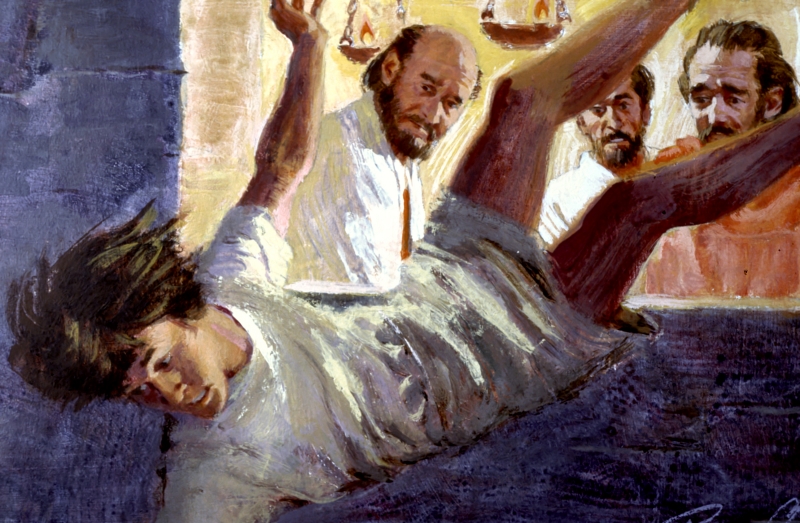 |
| Eutychus falling. Image from visualbiblealive.com |
Friday, May 17, 2013
Labeled a Legalist
If there's one thing that you don't want to be, it's a legalist. If you want to make a blanket accusation toward someone in a public dialogue that almost immediately discredits them, legalism is a good word to use. And if the accused has mentioned obedience, the accusation is likely to stick. That's an almost sure fire way to win a debate these days. Convince the hearers that your opponent is a legalist, and you win because legalism is bad.
Well, maybe you do want to be a legalist. At least some people do. I've heard some people unashamedly wear the name "legalist". I read this article, "Legalism: The Un-Sin" by Steve Klein in the Eastside church of Christ bulletin a couple of weeks ago. And, as an extreme example, Al Maxey posted this image on his Facebook page a few weeks ago (though Maxey certainly was not in agreement with the sentiment of the sign).
 |
| I wouldn't be comfortable saying that. |
The original source of that image was a well written blog post by Josh Collins. I don't know Josh Collins and I haven't read much of his blog, but I liked that post.
And, to make things more confusing, Anthony Bradley suggests that "radical" "missional" Christians are creating a new legalism. This article makes that point, nearly suggesting that those who try to do big things in service to others are legalistic and narcissistic. I've heard similar warnings about Francis Chan, David Platt, Shane Claiborne and others who suggest a radical commitment to following Jesus. I never thought that the word "legalism" would ever be used to describe the likes of Shane Claiborne or Francis Chan.
But, hey, if you don't like someone, call him a legalist.
So, there are those who insist that legalism is evil, soul destroying, joy robbing. There are others who insist that the only way to please God is to be a legalist. Still others throw it around as a label for people who do extraordinary things. Which is it? I'm so confused.
Let's look at the definition of legalism from dictionary.com.
legalism
noun
1.strict adherence, or the principle of strict adherence, to law or prescription, especially to the letter rather than the spirit.
2.Theology
a. the doctrine that salvation is gained through good works.
b. the judging of conduct in terms of adherence to precise laws.
So, here's what I think. I think that when people suggest that legalism is okay, they are using definition number 1 (though they would likely disagree with the "letter rather than the spirit" part). When folks are criticizing legalism, they are using definition number 2. So, what we have here is a misunderstanding of the terms. So, this begs the question... How does the Bible use the word "legalism"? IT DOESN'T!
So, what are we to do? If we're going to use the term, I think we have to be very specific in how we use it, and we have to specifically state what we mean. But that's a lot of trouble. So, how about we just not use the term? I don't think that's really the answer, either. It is a word and it does have meaning. I've used it, and I believe it has its place. However, I believe I'll be much more specific when I use the term from now on.
What I've seen happen far too often is this. Someone says, "you're a legalist." The accused may say, "yes, I am and so was Jesus." Then, the two walk away from the discussion not having communicated at all. The accuser thinks that the accused legalist believes in salvation through good works. The accused legalist thinks that his accuser doesn't believe in obeying God's laws. And neither one understands what the other believes.
To be clear, I'm not saying that there is no such thing as legalism (definition 2 above). It is real and I have been guilty of it. I am not above it. There are times that I still trust in my own works. There are times that I think I am better than others because my works are better than theirs. There are times that I make rules that God didn't make and I attempt to bind those rules on others and judge them for not following my rules. That is what I mean when I say legalism. Legalism is real. It's hypocrisy. It's joy robbing. It's evil. But "legalism" doesn't mean "more conservative (or more strict or more demanding) than me".
So, here's what we do. We label anyone more conservative than us as legalists or Pharisees or bigots. We label anyone more liberal than us as digressive or lax or permissive. We label people close to us as good and right. But all too often what we want to do is create a label and stick it on someone and then we'll know what to think about them and we'll know that we're better than they are because they have a bad label. This isn't at all Christ-like.
Tuesday, May 7, 2013
Creeds
The quote below comes from a pamphlet written by Barton W. Stone sometime near 1832. Much of what he says still rings true nearly two centuries later in 2013.
Not long ago, I was having a private conversation with a friend during which he pointed out one of our (By "our," I am referring to my faith heritage.) unwritten rules. He then compared our behavior in this matter toward new converts to the behavior of the strict Jews in Acts 15. Wow. He was spot on.
The situation in Acts 15 is that there are some new Gentile converts in Antioch. Some Jews, claiming to have authority from Jerusalem, began teaching that the Gentiles had to be circumcised also. Faith in Jesus was good, they said, but it was just a start. Those Gentiles needed to become more like Jews.
 The elders and apostles in Jerusalem, with much prayer, discussion, study, and guidance from the Holy Spirit wrote a letter (Acts 15:28-29) to distribute among the brethren at that time. I find that a fascinating glimpse at how inspiration might work. I had always thought that God's will would be made more directly clear to the inspired apostles. Apparently, however, there was sometimes more to it than a trance or vision or sudden clear revelation. This was an open discussion about the topic with input from several people, with the scripture being read, and all this in the Spirit's presence. That's an example we'd do well to follow.
Notice the gist of this whole meeting that produced the letter: "We are saved by the grace of Jesus. They are saved by the grace of Jesus. We shouldn't add to that. Therefore, they must give up idolatry, but they don't need to take on our rules." Wow! That's not very exclusive at all. The letter didn't even exclude the Jews who were insisting on circumcision. It did correct their teaching, but it did not exclude them. Later, because of their continued divisiveness in spite of the apostles and Holy Spirit making it clear that the Gentiles were included, those Jews who continued to exclude, were marked and excluded. But they were marked and excluded because they were trying to exclude!
The gospel invites and includes. Creeds, whether written or not, exclude. Huge difference. If my message is exclusive, should I not ask, "Is it the gospel, or is it a creed?"
Have you ever stopped to think, "Why did the Jews want to bind circumcision?" One possible reason is that they wanted access to God to be the same way they had received it. They wanted Christians to look like Jews, too. They didn't want wild pagans to have access to their God. There was definitely a culture clash between Jews and Gentiles in the first century.
Are we the same way? Do we want all Christians to look like us? Do we want to be sure that they dress a certain way (conservative, white, American, and please hide your tattoos), that they observe the Lord's Supper at a certain time and in a certain way (only every Sunday, and only a small pinch of pie crust and a teaspoon or so of Welch's, please, no singing or any noise at this time, and we'd prefer you to just pass the plate if you're not one of us), that they worship the same way we do (traditional songs, prayer, sermon, and offering, stand when we say stand, bow when we say bow, and sit when we say sit and don't make any unwelcome noise or ask any questions), basically that they do things the way we do them? Do we believe that to become a Christian (or at least to remain a Christian), you must do things like we do them? And if you don't do them that way, then do we say that you're not really a Christian?
If our attitude and practice is thus, how are we different from the Jews in Acts 15? How are we welcoming? How are we inclusive? How are we inviting the lost and troubled? Short answer, we're not. We're instead rehearsing and defending our comfortable creed while the world is suffering and dying.
Galatians 5:4 rings in my head loud and clear when I think of how I have treated new Christians and Christians outside of my own faith heritage. I have fallen from grace by binding rules and traditions that are contrary to grace. I've failed to be a conduit for God's grace to others by serving others sacrificially and proclaiming to them the resurrection Gospel. Instead of placing primary importance on the death, burial, and resurrection (1 Cor. 15:3-4), I've placed primary importance on "follow the rules like I do".
Rather than proclaiming the good news of God's kingdom's victory over evil, I've been telling people of the many barriers to entry into God's kingdom. Rather than tell a deeply powerful resurrection story and living a life that pushes darkness away, I have labored to convince people to be more like me, instead of more like Him.
There are two kinds of human authoritative creeds -- one is drawn up in articles, and written or printed in a book -- the other is a set of doctrines or opinions received but not committed to writing or printed in a book. Each of these kinds of creeds is used for the same purpose, which is to exclude from fellowship the man who dares to dissent from them. Of the two, we certainly give the preference to creeds written and published; because we can then read them, and form a more correct judgment of the doctrines contained in them.
There are some among us very clamorous against written or printed creeds who yet have a creed of their own of which they are as tenacious as any other sectarian is of his written creed; and they are equally intolerant against those who dissent from their doctrines or opinions.Brother Stone makes two great points in this passage. First, creeds do not have to be written to be real. When I defended an unwritten creed, I did not like to hear or think that I was defending an unwritten creed, but it didn't make it less true. And, what brother Stone says about creeds, whether written or not, is exactly right. Creeds have as their purpose to exclude from fellowship anyone who dares to dissent from them.
Barton W. Stone - An Address to the Churches of Christ c. 1832
Not long ago, I was having a private conversation with a friend during which he pointed out one of our (By "our," I am referring to my faith heritage.) unwritten rules. He then compared our behavior in this matter toward new converts to the behavior of the strict Jews in Acts 15. Wow. He was spot on.
The situation in Acts 15 is that there are some new Gentile converts in Antioch. Some Jews, claiming to have authority from Jerusalem, began teaching that the Gentiles had to be circumcised also. Faith in Jesus was good, they said, but it was just a start. Those Gentiles needed to become more like Jews.

Notice the gist of this whole meeting that produced the letter: "We are saved by the grace of Jesus. They are saved by the grace of Jesus. We shouldn't add to that. Therefore, they must give up idolatry, but they don't need to take on our rules." Wow! That's not very exclusive at all. The letter didn't even exclude the Jews who were insisting on circumcision. It did correct their teaching, but it did not exclude them. Later, because of their continued divisiveness in spite of the apostles and Holy Spirit making it clear that the Gentiles were included, those Jews who continued to exclude, were marked and excluded. But they were marked and excluded because they were trying to exclude!
The gospel invites and includes. Creeds, whether written or not, exclude. Huge difference. If my message is exclusive, should I not ask, "Is it the gospel, or is it a creed?"
Have you ever stopped to think, "Why did the Jews want to bind circumcision?" One possible reason is that they wanted access to God to be the same way they had received it. They wanted Christians to look like Jews, too. They didn't want wild pagans to have access to their God. There was definitely a culture clash between Jews and Gentiles in the first century.
Are we the same way? Do we want all Christians to look like us? Do we want to be sure that they dress a certain way (conservative, white, American, and please hide your tattoos), that they observe the Lord's Supper at a certain time and in a certain way (only every Sunday, and only a small pinch of pie crust and a teaspoon or so of Welch's, please, no singing or any noise at this time, and we'd prefer you to just pass the plate if you're not one of us), that they worship the same way we do (traditional songs, prayer, sermon, and offering, stand when we say stand, bow when we say bow, and sit when we say sit and don't make any unwelcome noise or ask any questions), basically that they do things the way we do them? Do we believe that to become a Christian (or at least to remain a Christian), you must do things like we do them? And if you don't do them that way, then do we say that you're not really a Christian?
If our attitude and practice is thus, how are we different from the Jews in Acts 15? How are we welcoming? How are we inclusive? How are we inviting the lost and troubled? Short answer, we're not. We're instead rehearsing and defending our comfortable creed while the world is suffering and dying.
Galatians 5:4 rings in my head loud and clear when I think of how I have treated new Christians and Christians outside of my own faith heritage. I have fallen from grace by binding rules and traditions that are contrary to grace. I've failed to be a conduit for God's grace to others by serving others sacrificially and proclaiming to them the resurrection Gospel. Instead of placing primary importance on the death, burial, and resurrection (1 Cor. 15:3-4), I've placed primary importance on "follow the rules like I do".
Rather than proclaiming the good news of God's kingdom's victory over evil, I've been telling people of the many barriers to entry into God's kingdom. Rather than tell a deeply powerful resurrection story and living a life that pushes darkness away, I have labored to convince people to be more like me, instead of more like Him.
Thursday, April 11, 2013
Would you please bring my stuff?
I've been considering for a long time how I should read my Bible. I wish I had a nice 1-2-3 formula for how to read the Bible, but I don't. The difficulty with answering the question, "How do I read the Bible?" is the question itself. It treats the Bible as one big monolithic book. It's not that at all.
In sermons about the inspiration and reliability of the Bible, I've heard it pointed out that the Bible is a collection of writings by about 40 different authors over a period of 1500 years. I've actually verified those claims and they are more or less accurate and I believe they are evidence of inspiration and reliability. So, my question is this... Why have I not remembered this diversity of authorship and history when it comes to interpretation? Why have I treated the Bible like it's monolithic? Like there is no difference in how we should interpret First Corinthians, Acts, and Leviticus?
The Pentateuch has a purpose and an author (or authors or at least editors) and a historical and cultural context and various literary styles. The same is true about Joshua. Consider how different the collection of Psalms is from the other books. Then there is Isaiah which is beautiful and unique. Ruth stands out as different and was possibly written at a different time than the setting of the story it tells. Daniel is an astounding mix of history and figures and foretelling. Each of the Gospels has an author, an intended audience, and purpose. Acts... Revelation... I shouldn't read any of those books exactly the same way. I could go on thinking about these things for the rest of the books of the Bible. What I conclude is that there is no one-size-fits-all formula to interpret all of them. Each of them is a unique book with an author and a purpose and a historical context and a literary style, etc.
Consider more recent literature originally written in my own native language by a single author and parts of this interpretive principle still hold true. I don't read all of C.S. Lewis's books the same way because I understand that they're different in style and purpose. Why, then, would I try to take a collection of writings by different authors over many centuries and force one single style of interpreting them?
It just doesn't make sense. It recently dawned on me that I was asking the wrong question. The question is not, "How do I read my Bible?" The question is "How do I read THIS writing?" Even with that, the question is still incomplete. Even though each book in the Bible is unique, I still have to also consider that it is a unique part of a whole story. Each book is part of a story that God invites us to join. There are various over-arching themes throughout both the Old and New Testaments. Those must be considered as well or I'll miss the point of what I'm reading. Reading the Bible is not a simple formulaic 1-2-3 process.
That absence of a simple formula doesn't mean the Bible is unintelligible or that its message is only available to the intelligentsia. Not at all! Its themes are quite accessible and I'm daily thankful for our unprecedented access to the inspired scripture. Jesus boiled ALL of it down to this: Love God and love the people He made (Matt. 22:37-40). Paul, in describing the fruit of the spirit, claims there is no law against those virtues, love, joy, peace, patience, etc. (Gal. 5:22-23). Peter, discussing "Christian graces," tells us to grow in these, faith, knowledge, love, etc. and we'll never stumble (2 Pet. 1:10). It's really not difficult to get the message. God is exactly like Jesus and He loves, serves, and forgives and He invites us to join Him in this work. God sure has made Himself accessible, even in creation itself (Rom. 1:20). God's truth is not limited to the elite.
No, God's truth and love and freedom are not only for the elite. What this absence of a uniform hermeneutic formula means is that the Bible will provide you with more than a lifetime of challenge and discovery. It's simply beautiful! The best advice I know to give anyone about reading the Bible right now is this, and this is just advice, not a formula.
The realization that I was asking the wrong question dawned upon me as I was reading through 2 Timothy, sent there by a reference to Hymenaeus and Philetus. This verse, 2 Tim. 4:13 jumped out at me during the reading.
Maybe, just maybe, that statement is there to remind us that we've been given the privilege of eavesdropping on a personal letter. Second Timothy was just that. A personal letter from Paul (I believe) to Timothy. And by skimming over this verse and others like it throughout the epistles (Tell Olympas 'nem I said hi... Rom. 16:15, etc.) for years and years, I've missed the truth that I'm not supposed to read 2 Timothy or the other epistles like a novel or a history book or legal document or, worse yet, like a blue print. I'm supposed to read 2 Timothy like it's a personal letter from an older brother to a younger brother in Christ and close friend that he loved dearly and missed greatly and had cried with many times because that's exactly what it is. It is not a church manual. It is not a creed. It is not even a preacher's manual. It is "Timothy, I love and appreciate you. Beware, some mean people are going to do some awful things to you like they have done to me. Keep your faith in the resurrection of Christ with sincere love and a pure conscience. Keep on preaching that, regardless of opposition. Brother, I can't wait to see you again." And when I keep in mind that it is that type of letter, I realize that many situations that applied to Timothy in that time do not apply to me in my time. I stop looking for specific instructions not written to me and that don't make sense to me and I instead drown my heart in the love and appreciation and principles that guided their relationship. That's what really teaches me and causes me to grow closer to God and my brethren. (Please don't misunderstand this to mean that there are no specifics that apply to us. See my last post where I point out that fasting is a specific that I have overlooked. Baptism is quite specific, etc.)
Could that be why those greetings and personal details are included? As a reminder of what we are reading? And if that's not THE reason, shouldn't their presence at least remind us of the truth that we're privileged to read a personal letter?
Rachel Held Evans has some interesting comments on this verse and several others like it. I think she is onto something. Please read that blog entry of hers.
I believe the Bible is inspired, all of it. I believe it is one way that God communicates to us. I believe it is God telling us the story of His people. I do not believe it is "just" a story, but I do believe it tells a story. I believe God invites us to join in His story and become His people. If I accept the Bible for what it is and how He gave it to us instead of trying to make it what I want it to be, it will mold me, transform me, challenge me, and point me to His Son. It will make me more like Him.
In sermons about the inspiration and reliability of the Bible, I've heard it pointed out that the Bible is a collection of writings by about 40 different authors over a period of 1500 years. I've actually verified those claims and they are more or less accurate and I believe they are evidence of inspiration and reliability. So, my question is this... Why have I not remembered this diversity of authorship and history when it comes to interpretation? Why have I treated the Bible like it's monolithic? Like there is no difference in how we should interpret First Corinthians, Acts, and Leviticus?
The Pentateuch has a purpose and an author (or authors or at least editors) and a historical and cultural context and various literary styles. The same is true about Joshua. Consider how different the collection of Psalms is from the other books. Then there is Isaiah which is beautiful and unique. Ruth stands out as different and was possibly written at a different time than the setting of the story it tells. Daniel is an astounding mix of history and figures and foretelling. Each of the Gospels has an author, an intended audience, and purpose. Acts... Revelation... I shouldn't read any of those books exactly the same way. I could go on thinking about these things for the rest of the books of the Bible. What I conclude is that there is no one-size-fits-all formula to interpret all of them. Each of them is a unique book with an author and a purpose and a historical context and a literary style, etc.
Consider more recent literature originally written in my own native language by a single author and parts of this interpretive principle still hold true. I don't read all of C.S. Lewis's books the same way because I understand that they're different in style and purpose. Why, then, would I try to take a collection of writings by different authors over many centuries and force one single style of interpreting them?
It just doesn't make sense. It recently dawned on me that I was asking the wrong question. The question is not, "How do I read my Bible?" The question is "How do I read THIS writing?" Even with that, the question is still incomplete. Even though each book in the Bible is unique, I still have to also consider that it is a unique part of a whole story. Each book is part of a story that God invites us to join. There are various over-arching themes throughout both the Old and New Testaments. Those must be considered as well or I'll miss the point of what I'm reading. Reading the Bible is not a simple formulaic 1-2-3 process.
That absence of a simple formula doesn't mean the Bible is unintelligible or that its message is only available to the intelligentsia. Not at all! Its themes are quite accessible and I'm daily thankful for our unprecedented access to the inspired scripture. Jesus boiled ALL of it down to this: Love God and love the people He made (Matt. 22:37-40). Paul, in describing the fruit of the spirit, claims there is no law against those virtues, love, joy, peace, patience, etc. (Gal. 5:22-23). Peter, discussing "Christian graces," tells us to grow in these, faith, knowledge, love, etc. and we'll never stumble (2 Pet. 1:10). It's really not difficult to get the message. God is exactly like Jesus and He loves, serves, and forgives and He invites us to join Him in this work. God sure has made Himself accessible, even in creation itself (Rom. 1:20). God's truth is not limited to the elite.
No, God's truth and love and freedom are not only for the elite. What this absence of a uniform hermeneutic formula means is that the Bible will provide you with more than a lifetime of challenge and discovery. It's simply beautiful! The best advice I know to give anyone about reading the Bible right now is this, and this is just advice, not a formula.
- Read it frequently and thoroughly.
- It is about Jesus from beginning to end. Never forget that while reading any part of it.
- Jesus is exactly what God is like and His nature is especially revealed on the cross. Therefore, read anything inspired by God with an extreme bias of love for the unlovable, forgiveness for the unforgivable, mercy over judgment, and with the knowledge that self-sacrificial love overcomes evil and hatred and bitterness and division and violence.
- Remember that it wasn't written to you all at once by one person.
.JPG) |
| My coat and books |
The cloak that I left at Troas with Carpus, when thou comest, bring with thee, and the books, but especially the parchments.Why on earth is this included for us? How is this part of God's story? What can I learn from this? That Paul was forgetful? That it was spring when he left Troas and he didn't need his coat? Or maybe that he was generous and loaned Carpus his coat? Is this why he wanted Timothy to come before winter (verse 21)? What were the books? Were they Scripture? What did Paul read anyway? Did he have notes he had written and wanted to review them again and the Holy Spirit couldn't just make those thoughts reappear in his mind? What is this verse and why is it here? And why did I forget this verse existed? If every word of the Bible is inspired why wasn't I ever tasked to memorize this verse or the dozens of greetings and personal notes in Paul's letters?
Maybe, just maybe, that statement is there to remind us that we've been given the privilege of eavesdropping on a personal letter. Second Timothy was just that. A personal letter from Paul (I believe) to Timothy. And by skimming over this verse and others like it throughout the epistles (Tell Olympas 'nem I said hi... Rom. 16:15, etc.) for years and years, I've missed the truth that I'm not supposed to read 2 Timothy or the other epistles like a novel or a history book or legal document or, worse yet, like a blue print. I'm supposed to read 2 Timothy like it's a personal letter from an older brother to a younger brother in Christ and close friend that he loved dearly and missed greatly and had cried with many times because that's exactly what it is. It is not a church manual. It is not a creed. It is not even a preacher's manual. It is "Timothy, I love and appreciate you. Beware, some mean people are going to do some awful things to you like they have done to me. Keep your faith in the resurrection of Christ with sincere love and a pure conscience. Keep on preaching that, regardless of opposition. Brother, I can't wait to see you again." And when I keep in mind that it is that type of letter, I realize that many situations that applied to Timothy in that time do not apply to me in my time. I stop looking for specific instructions not written to me and that don't make sense to me and I instead drown my heart in the love and appreciation and principles that guided their relationship. That's what really teaches me and causes me to grow closer to God and my brethren. (Please don't misunderstand this to mean that there are no specifics that apply to us. See my last post where I point out that fasting is a specific that I have overlooked. Baptism is quite specific, etc.)
Could that be why those greetings and personal details are included? As a reminder of what we are reading? And if that's not THE reason, shouldn't their presence at least remind us of the truth that we're privileged to read a personal letter?
Rachel Held Evans has some interesting comments on this verse and several others like it. I think she is onto something. Please read that blog entry of hers.
I believe the Bible is inspired, all of it. I believe it is one way that God communicates to us. I believe it is God telling us the story of His people. I do not believe it is "just" a story, but I do believe it tells a story. I believe God invites us to join in His story and become His people. If I accept the Bible for what it is and how He gave it to us instead of trying to make it what I want it to be, it will mold me, transform me, challenge me, and point me to His Son. It will make me more like Him.
Monday, April 1, 2013
My First Lent
Until this year, Lent never had any meaning to me. The environment and culture that has shaped me has never given any importance to Lent, so neither have I. It just simply hasn't been something that has ever been on my radar. I had always assumed that Lent was just something people did because some "religious authority" told them it was time to do it. I always thought Lent was a totally man-made idea and that it was kinda silly to give up something that wasn't sinful per se just to be giving it up. I always thought it was a self-righteous look-at-me-and-how-humble-I-am kind of thing. I simply couldn't imagine how Lent could have any real spiritual value.
Boy, was I wrong. And self-righteous.
Last year, I was on business travel during the Lenten season. A man that I was working with was observing Lent. His brother is a Catholic priest and he is a devout Catholic. I had a zillion questions for him. He graciously took the time to explain Lent to me. Mind you, I have not verified any of his explanation with a google or independent research. I just took him at his word and I'm going from a year old memory. So, what I say here may be an inaccurate restatement of an inaccurate description. But I don't think it really matters.
This is the gist of what I remember from him.
 So, this year, I decided to give it a try. Now, some with a similar faith-heritage (American Restoration Movement) may think my trying this is odd, but please allow me to defend myself. Fasting is something that has been pretty much ignored in our heritage. I have heard rare mention in Bible classes and private studies. I have maybe heard a couple of mentions out of literally thousands of sermons over the years. That avoidance of this command seems odd for a group that claims to follow the New Testament pattern and claims to do exactly what the Bible says. Jesus said (paraphrasing Matt. 9:15; Mark 2:19; and Luke 5:34-35) that when He leaves the earth, His disciples will fast. We see the early Christians fasting in Acts (Acts 13:2-3; 14:23) and Paul encouraging it for the Corinthians (1 Cor. 7:5; 2 Cor. 6:5). If I don't fast, I have to ask myself, "Am I a disciple of Christ?" Fasting is a characteristic of Christ's post-ascension disciples clearly set forth in the New Testament. No specific time or procedure is set forth in the New Testament for fasting, so I do not criticize or condemn anyone for not observing Lent or any other specific fast. However, speaking for myself, fasting is something that I had never given any serious consideration. I believe I was missing something good for me, given from God. Lent seemed as good an opportunity as any to begin to obey God in this.
Since the rules for Lent are not specific, you can choose what you will give up, but it shouldn't be easy. So, in choosing what to give up, I was looking for something that was not easy for me and something that would have a physical and spiritual benefit. I chose three fairly common things to give up: meat (except fish), chocolate, and ice cream. Sound easy? It was and it wasn't.
First, giving up meat is something that I have been working on for over a year now. I haven't completely given it up, mainly because I live in the South and it's sometimes just plain rude to be a vegetarian. Also, I do enjoy eating meat. Those two things combine to make it difficult for me to give up meat. But I want to abstain from meat as much as possible.
I believe that the meat we consume today makes its way to our table in extremely unethical and unnatural ways. It is not good for us physically because of the antibiotics and steroids and GMO corn based diet of the animals. Also, modern factory farms are inhumane. Finally, and most important to me is the mental health of the employees in factory farms and modern slaughter houses. Those people suffer greatly and my conscience disturbs me when I eat factory farmed flesh. Sometimes, though, I'm in a situation of choosing the lesser of two evils. Eating meat that would likely be thrown away otherwise seems less evil than directly insulting someone's loving and thoughtful effort to serve me. And sometimes, I just want a steak or a cheeseburger, so I order one. I don't judge you for eating meat. (Ok, I'll end my meat rant now and leave it at saying I wish there were something more I could do to improve the process of supplying meat to American consumers.)
So, a big spiritual benefit of giving up meat is that I daily prayed for workers in factory farms and slaughterhouses. Their plight was often on my mind and I prayed for them. I prayed for wisdom and opportunity to help. I prayed that more humane ways of beef, pork, and poultry farming would emerge. While I did eat meat twice during Lent, I did become more conscious of the life and freedom that was lost for my own pleasure.
Chocolate and ice cream were exercises in self-control that I needed. As I was tempted to partake, I reminded myself that this life is not about pleasure for myself. Depriving myself of pleasure is necessary to accomplish any worthy goal. I had become a daily consumer of ice cream and/or chocolate, and I was a slave to its pleasure more than I realized. Lent helped me to break those chains. Also, I cheated, three times during the six weeks. That's not a good record. It reminded me of Jesus in His 40 days and how infinitely more difficult it was for Him to resist making stones to bread. It made me appreciate His lifetime of self-control in a way that I hadn't before.
There were a few unexpected consequences of observing Lent. One was that I felt a connection to Christians throughout the world with other cultural and traditional backgrounds. Also, I felt a connection to history and sensed the value of church traditions that is sometimes lost in modern American evangelicalism.
The biggest unexpected consequence was that I longed to celebrate Easter. That seemed to me to naturally grow from the Lenten season. I gave special attention to the stories on each day of holy week. I read and meditated upon the accounts of the last week of Jesus' life. It was a very special time of study, meditation, and prayer for me. And I was rewarded and surprised with an outstanding telling of the resurrection story and an amazing sermon on the importance of the resurrection of Jesus on Easter Sunday morning.
Now, here again, this may seem odd to those in my tribe (American Restoration Movement). We are more accustomed to viewing Easter something like this... "Easter is not mentioned in the New Testament. Remembering the resurrection should not be just an annual event. We're commanded to remember the death of our Lord every first day of the week by observing the Lord's Supper." To that I respond this way... First, it is true that remembering the resurrection should not just be done annually. The resurrection should be ever present in our minds. Second, we're not commanded to take the Lord's Supper every week. There is an example of one church intending to observe the Lord's Supper one Sunday (Acts 20:7), but they didn't actually observe it on Sunday (Acts 20:11). Also, there's nothing that makes that mandatory for all churches everywhere. And the resurrection isn't really the emphasis of the Lord's Supper anyway. Third, if every Sunday is special, then no Sunday is special. Fourth, why would we miss an opportunity to talk about the resurrection? Paul sought every opportunity to talk about the resurrection. If people are already thinking about the resurrection of Jesus on a specific Sunday, why would we NOT talk about it? When is a good time to talk about the resurrection of Jesus? ANY TIME. ALL THE TIME. Finally, Easter is not like Christmas. In America, Christmas has become so commercialized that I can't imagine it ever overcoming the consumerism, avarice, and indulgence. Also, we don't know when Jesus was born. Easter, on the other hand, is not nearly as commercialized. And though there is some dispute between Eastern and Western churches about exactly which Sunday, we have a very good idea of which Sunday Jesus arose in relation to the Jewish calendar. While I never would insist that anyone observe any holiday, I totally reject the notion that it is a sin to observe Easter as a holiday. I am 100% opposed to condemning someone for observing Easter.
So, what's the point of all of this? What is the take-away? It's not, "Observe Lent," though you can and I'd recommend it at least once. It's not "We need to fast," though we do and I need to do it more. It's not "Easter is okay," though Easter is okay and is a great opportunity to talk about resurrection. It's not "Become a vegetarian," though that is a healthier and more sustainable choice. Those are all things that I learned through observing Lent, but none of those are the main point.
Here's the main point I learned. Do not assume that someone else's chosen way to honor God is less spiritual than your chosen way to honor God. Do not assume that others' traditions and customs have no value because they are not your traditions and customs. God can use a variety of actions to draw a pure heart closer to Him. I'm glad He used Lent this year to draw me closer to Him. I pray that I learned lasting lessons about self-control, prayer, and love so that I can be more like Him.
Boy, was I wrong. And self-righteous.
Last year, I was on business travel during the Lenten season. A man that I was working with was observing Lent. His brother is a Catholic priest and he is a devout Catholic. I had a zillion questions for him. He graciously took the time to explain Lent to me. Mind you, I have not verified any of his explanation with a google or independent research. I just took him at his word and I'm going from a year old memory. So, what I say here may be an inaccurate restatement of an inaccurate description. But I don't think it really matters.
This is the gist of what I remember from him.
- Lent isn't supposed to be easy. (That, in and of itself probably gives it some value. Most things worth doing are not easy, so if it's nothing more than an exercise in doing something difficult, it probably still has value.) Giving up meat except for fish doesn't mean that you get fish and chips and sushi every day. The rules are not hard, fast rules. As a result, there are no loopholes. Sure, there is the Friday fish fry, but it's not quite that specific that you must give up meat and you must eat fish. You're supposed to overcome desires. It is a spiritual exercise in self-control.
- The 40 days comes from the 40 days that Jesus was in the wilderness fasting. And 40 days is more or less 40 days, not exact. Some people take Sundays off from lent. But the idea is to remind us of the fasting Jesus did for 40 days.
- The main point of Lent is to make you more humble. It is NOT "look at me fasting, praying, and giving." It is a deeply personal thing designed to humble you and draw you nearer to God. Humility is the key to Lent.

Since the rules for Lent are not specific, you can choose what you will give up, but it shouldn't be easy. So, in choosing what to give up, I was looking for something that was not easy for me and something that would have a physical and spiritual benefit. I chose three fairly common things to give up: meat (except fish), chocolate, and ice cream. Sound easy? It was and it wasn't.
First, giving up meat is something that I have been working on for over a year now. I haven't completely given it up, mainly because I live in the South and it's sometimes just plain rude to be a vegetarian. Also, I do enjoy eating meat. Those two things combine to make it difficult for me to give up meat. But I want to abstain from meat as much as possible.
I believe that the meat we consume today makes its way to our table in extremely unethical and unnatural ways. It is not good for us physically because of the antibiotics and steroids and GMO corn based diet of the animals. Also, modern factory farms are inhumane. Finally, and most important to me is the mental health of the employees in factory farms and modern slaughter houses. Those people suffer greatly and my conscience disturbs me when I eat factory farmed flesh. Sometimes, though, I'm in a situation of choosing the lesser of two evils. Eating meat that would likely be thrown away otherwise seems less evil than directly insulting someone's loving and thoughtful effort to serve me. And sometimes, I just want a steak or a cheeseburger, so I order one. I don't judge you for eating meat. (Ok, I'll end my meat rant now and leave it at saying I wish there were something more I could do to improve the process of supplying meat to American consumers.)
So, a big spiritual benefit of giving up meat is that I daily prayed for workers in factory farms and slaughterhouses. Their plight was often on my mind and I prayed for them. I prayed for wisdom and opportunity to help. I prayed that more humane ways of beef, pork, and poultry farming would emerge. While I did eat meat twice during Lent, I did become more conscious of the life and freedom that was lost for my own pleasure.
Chocolate and ice cream were exercises in self-control that I needed. As I was tempted to partake, I reminded myself that this life is not about pleasure for myself. Depriving myself of pleasure is necessary to accomplish any worthy goal. I had become a daily consumer of ice cream and/or chocolate, and I was a slave to its pleasure more than I realized. Lent helped me to break those chains. Also, I cheated, three times during the six weeks. That's not a good record. It reminded me of Jesus in His 40 days and how infinitely more difficult it was for Him to resist making stones to bread. It made me appreciate His lifetime of self-control in a way that I hadn't before.
There were a few unexpected consequences of observing Lent. One was that I felt a connection to Christians throughout the world with other cultural and traditional backgrounds. Also, I felt a connection to history and sensed the value of church traditions that is sometimes lost in modern American evangelicalism.
The biggest unexpected consequence was that I longed to celebrate Easter. That seemed to me to naturally grow from the Lenten season. I gave special attention to the stories on each day of holy week. I read and meditated upon the accounts of the last week of Jesus' life. It was a very special time of study, meditation, and prayer for me. And I was rewarded and surprised with an outstanding telling of the resurrection story and an amazing sermon on the importance of the resurrection of Jesus on Easter Sunday morning.
Now, here again, this may seem odd to those in my tribe (American Restoration Movement). We are more accustomed to viewing Easter something like this... "Easter is not mentioned in the New Testament. Remembering the resurrection should not be just an annual event. We're commanded to remember the death of our Lord every first day of the week by observing the Lord's Supper." To that I respond this way... First, it is true that remembering the resurrection should not just be done annually. The resurrection should be ever present in our minds. Second, we're not commanded to take the Lord's Supper every week. There is an example of one church intending to observe the Lord's Supper one Sunday (Acts 20:7), but they didn't actually observe it on Sunday (Acts 20:11). Also, there's nothing that makes that mandatory for all churches everywhere. And the resurrection isn't really the emphasis of the Lord's Supper anyway. Third, if every Sunday is special, then no Sunday is special. Fourth, why would we miss an opportunity to talk about the resurrection? Paul sought every opportunity to talk about the resurrection. If people are already thinking about the resurrection of Jesus on a specific Sunday, why would we NOT talk about it? When is a good time to talk about the resurrection of Jesus? ANY TIME. ALL THE TIME. Finally, Easter is not like Christmas. In America, Christmas has become so commercialized that I can't imagine it ever overcoming the consumerism, avarice, and indulgence. Also, we don't know when Jesus was born. Easter, on the other hand, is not nearly as commercialized. And though there is some dispute between Eastern and Western churches about exactly which Sunday, we have a very good idea of which Sunday Jesus arose in relation to the Jewish calendar. While I never would insist that anyone observe any holiday, I totally reject the notion that it is a sin to observe Easter as a holiday. I am 100% opposed to condemning someone for observing Easter.
So, what's the point of all of this? What is the take-away? It's not, "Observe Lent," though you can and I'd recommend it at least once. It's not "We need to fast," though we do and I need to do it more. It's not "Easter is okay," though Easter is okay and is a great opportunity to talk about resurrection. It's not "Become a vegetarian," though that is a healthier and more sustainable choice. Those are all things that I learned through observing Lent, but none of those are the main point.
Here's the main point I learned. Do not assume that someone else's chosen way to honor God is less spiritual than your chosen way to honor God. Do not assume that others' traditions and customs have no value because they are not your traditions and customs. God can use a variety of actions to draw a pure heart closer to Him. I'm glad He used Lent this year to draw me closer to Him. I pray that I learned lasting lessons about self-control, prayer, and love so that I can be more like Him.
Wednesday, March 20, 2013
God Suffers with Us
I don't make any claim to be an expert on the topic of suffering. It's just a topic that I've thought about quite a bit lately. I feel a bit inadequate to even address this. Though I've experienced some suffering, I am really blessed beyond description. I have had a very easy life. Honestly, that bothers me some. I don't know what Paul meant when he said, "I know how to abound and I know how to be abased." I only have proof that I don't know very well how to abound. But, here go some of my thoughts on suffering, especially how that the presence of suffering does not imply that God is not good.
You probably remember the story of the young boy in Alabama who was held hostage in a bunker for 5 days. That story was bizarre to say the least. The boy was rescued and returned to his parents safely, but I wouldn't call anything about that story happy, not even the ending. The innocent bus driver was shot and killed when the boy was kidnapped. The angry and violent kidnapper was shot and killed when the boy was rescued. (No, I do not think that is happy.) The young boy had to suffer indescribable fear and anxiety for 5 days and saw too much death and violence. And the parents... I can't imagine their agony and worry. No, there is nothing happy here.
The day the boy was rescued, February 4, 2013, an atheist friend of mine posted something similar to this on Facebook.
I'm a little curious seeing all the posts about this rescue being an answer to prayers... Did god not see fit to protect the bus driver or prevent the child from suffering 5 days as a hostage?Okay, Christians, we have to admit that he has a point. How do we know that his rescue was an answer to prayer? Yes, we know that prayers were offered on behalf of the boy. Yes, we know that God did not want the boy to suffer. But how do we know that God intervened in any supernatural or providential way to rescue the boy? Do we know that? No, we don't know the answers to those questions. Yes, prayer works and is helpful. But why did God not answer sooner? Why did God not prevent the murder of the bus driver as he valiantly tried to protect the children? Why did God not make a way for the boy to be rescued without witnessing the killing of the kidnapper?

Also, I don't know why my grandfather suffered from Alzheimer's disease until he couldn't recognize his own children when he died. I don't know why my best friend lost his amazing dad when we were 12 years old. I. Don't. Know. I do know that prayers were offered in all of those cases. And I do know that God is good and He hears and cares and He is able to do anything that is possible. But apparently, eliminating suffering from this cosmos without re-creating it is not possible. (On a side note, re-creating it is something that God has promised He will do.)
Back to my atheist friend. I am always slow to think of what to say. I missed an opportunity because I'm slow. I didn't say anything because I was looking for the right words. If I had said something, this is what I would have said.
There have been times that I have looked at the beauty and the expanse of the universe we live in and said, "There must be a god." At other times, I've looked at the immeasurable suffering and said, "There can't be a god, at least not a good one." I confess, I don't have the answers for the suffering and evil I see. I don't understand why some prayers seem to be answered and some are not. And I even confess that I don't know whether the young boy's rescue was an answer to prayer or not. But I know that his rescue was good. And his capture and the bus driver's murder was bad. Even the kidnappers death was bad. The world is full of both good and bad. So, I can't believe in a God whose goodness is defined by the absence of suffering. That's contrary to mounds of evidence that I see. Some may accuse me of making God in my own image, but the only God I can believe in is one who knows what it's like to suffer. That's precisely the God that the gospel reveals, One who suffered immensely and unjustly and chose not to protect Himself from it. Even His own prayer for relief from suffering went unanswered. Yet He loved and did good for others and helped bring relief and comfort in their suffering. I want to love and follow a God like that.I'm sorry that I missed an opportunity to share God's love with my atheist friend. I'd love for him to see and understand that God isn't really like many people say that He is. God is not a cosmic vending machine. Many portray Him that way, and it is an illogical turn off for skeptics.
A couple of weeks after this story, I was asked to choose my favorite passage from the Bible and read it to the congregation and make a short comment about it. This is what I chose and roughly what I said.
Mark 15:34. And at the ninth hour Jesus cried with a loud voice, "Eloi, Eloi, lema sabachthani?" which means, "My God, My God, why have You forsaken Me?"I don't have answers. I'm a miserable comforter to those who are suffering. All I know to do is weep with those who weep. Even what I've said here probably seems like platitudes and pat answers. But what I do when I'm suffering is trust. I trust Him who suffered not only for me, but so He can relate to me. I pray that I can learn to face suffering courageously and to gently and lovingly comfort those who are suffering, more like Him.
With all the suffering that I see and have experienced in the world, you can say I'm making God in my own image if you want, but I can't worship a God who keeps Himself above all the suffering. I can't worship a God who blames others for suffering and gives pat answers about what is good and takes no responsibility for suffering. No, I worship a God who knows exactly what it's like to feel God forsaken and completely overwhelmed with emotional and physical pain, and to even have His prayer for relief from suffering go unanswered (Mark 14:36). I worship a God who joins us in our suffering.
Subscribe to:
Posts (Atom)